


Last Updated: October 29, 2026
Quick Summary
Bulk uniform sizing is the process of collecting, recording and applying accurate body measurements across a whole workforce so every garment fits first time. Build a repeatable five-stage workflow: plan the size range, measure staff consistently, record sizes on one shared form, sample garments before committing to volume, then order to a size profile.
- Take five measurements in centimetres: chest or bust, waist, hip, inside leg and shoulder.
- Order one or two fitting samples in your most-used sizes and try them on real staff first.
- Order slightly more of the middle sizes and keep a small buffer for new starters.
- Record the supplier's exchange and replenishment terms at the point of order.
- Restrict the master sizing form to named administrators and set a retention period.
Table of Contents
- Step 1: Build a Repeatable Bulk Uniform Sizing Workflow
- Step 2: How to Measure for Workwear Accurately
- Step 3: Create a Staff Uniform Sizing Form That Works
- Step 4: Order Workwear Fitting Samples Before You Commit
- Step 5: Plan Your Uniform Size Range and Quantities
- Inclusive Sizing, Privacy and Sizing Across Garment Ranges
- Get a Quote and Start Your Bulk Uniform Order
- Frequently Asked Questions
Step 1: Build a Repeatable Bulk Uniform Sizing Workflow
Getting bulk uniform sizing right starts with a process, not a tape measure. A repeatable workflow is the difference between a team that looks sharp on day one and a drawer full of returns.
Here are five stages that make bulk sizing manageable:
- Plan the size range and who needs what
- Measure staff using a consistent method
- Record sizes on a single shared form
- Sample garments before committing to volume
- Order and review quantities against real fit data
Sampling is a stage many teams skip, and it is a common source of fit-related returns.
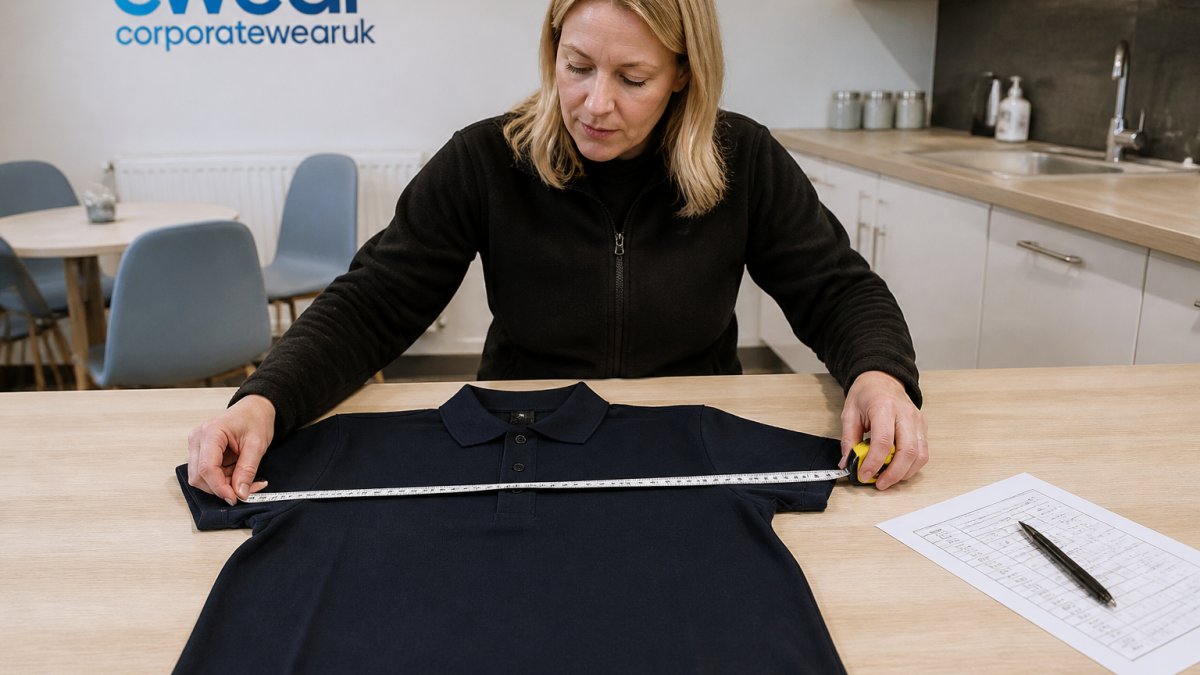
Step 2: How to Measure for Workwear Accurately
Accuracy comes down to five numbers, taken the same way every time. A common mistake is letting staff guess their size from a high-street label. Workwear cuts run differently from fashion sizing, so a tape measure beats a remembered size every time. Comparing your figures against a Slim Fit Workwear Oxford Shirt Long Sleeved Slim Fit product listing shows how its size and fit details line up with your measurements.
The five measurements that decide garment fit
- Chest or bust: around the fullest part, tape level and flat
- Waist: at the natural waistline, not where trousers sit
- Hip: around the fullest part of the seat
- Inside leg: from crotch to ankle along the inside leg
- Shoulder: across the back, seam to seam
Use a soft tape measure and keep it snug, not tight. Take each measurement over light clothing. Record everything in centimetres for consistency. A Pro Workwear Cargo Trousers product listing lets you compare leg, waist and rise measurements against your own.
Step 3: Create a Staff Uniform Sizing Form That Works
A good form removes guesswork and keeps every size in one place. The best staff uniform sizing form is short, uses the same units throughout, and captures role and quantity alongside each measurement.
Build yours with these fields:
- Employee name and department
- Role and garment types required
- The five body measurements in centimetres
- Preferred fit (regular or slim)
- Quantity of each garment
- Date measured and who took it
Keep one master sheet, not a dozen email threads. A single source of truth makes reordering and replenishment far easier later.
Watch out: if staff self-report sizes with no measurement step, you will inherit the fit problems you were trying to avoid.
Step 4: Order Workwear Fitting Samples Before You Commit
Sampling is the cheapest insurance in uniform procurement. Order one or two garments in the sizes you expect to use most, try them on real staff, then adjust before the bulk order goes in. A Richmond Stretch Workwear Jacket makes a representative sample to order before committing to bulk. This is how you catch a cut that runs small before it becomes fifty returns.
Run the sample try-on as a short session:
- Have staff wear the garment over their usual base layers
- Check reach, bend and stretch in the shoulders and waist
- Note any size swaps on the master form
- Confirm embroidery placement at the same time
Once the sample fits, the size profile is set and the bulk order becomes routine.
Step 5: Plan Your Uniform Size Range and Quantities
Quantity planning is where budget and fit meet. Uniform size range planning means mapping your measured sizes onto the sizes a supplier actually stocks, then ordering to that profile rather than to a flat guess.
Start with your master form and group staff by size. Order slightly more of the middle sizes and fewer of the extremes, then keep a small buffer for new starters. Check minimum order quantity, unit price and lead time before you commit.
Build a size profile, not a flat order
A size profile is the count of staff in each size for each garment. Build it from the master form and check it against the supplier's stock range before ordering. A simple pattern is to order to the measured profile plus a small buffer in the middle sizes, adjusted for your expected turnover. Confirm the supplier's minimum order quantity per size and per colour, because a size that falls below the minimum may need to be consolidated or substituted. An extended-size product listing shows the full size span available for planning your range.
| Stage | What you do | Why it matters |
|---|---|---|
| Plan | Map roles to garments | Avoids over-ordering |
| Measure | Take five measurements | Sets an accurate baseline |
| Record | Use one shared form | Keeps data consistent |
| Sample | Try before bulk order | Cuts fit-related returns |
| Order | Order to the size profile | Controls cost and stock |
Plan for what happens after delivery
Even a well-run bulk order will need corrections. Build contingency into the plan before the order goes in:
- Late hires and leavers: hold a small reserve of the most common sizes so a new starter is not waiting for a full reorder
- Exchanges: agree the supplier's exchange window and whether returns are credited, replaced or exchanged, and record the terms alongside the order
- Stock shortages: ask which sizes are held in stock and which are made to order, so you know where a delay is likely
- Incorrect sizes: keep the fit sample and the master form so a replacement can be ordered in the right size without re-measuring the whole team
- Replenishment: set a review point, for example, quarterly or at each new intake, and reorder against the size profile rather than from memory
Record the supplier's exchange and replenishment terms at the point of order. A short written note on lead times, minimum quantities and exchange windows saves a difficult conversation later.
A repeatable size profile plus a documented contingency plan is what turns a one-off bulk order into a uniform programme that survives staff turnover, supplier stock changes and the occasional wrong size.
Inclusive Sizing, Privacy and Sizing Across Garment Ranges
Inclusive sizing is not a nice-to-have, it is a fit requirement. Build extended sizes into the range from the start, and offer alternatives where a cut does not suit a role.
Making the range genuinely inclusive
Inclusive sizing means planning for the full spread of body shapes on your team, not just adding a token 4XL at the end of the chart. A practical approach is to:
- Confirm the supplier's actual size span per garment, including extended sizes, before you publish the form
- Offer more than one cut where a single unisex block will not suit every role, for example, a women's-fit blouse alongside a unisex shirt
- Account for modesty preferences by offering layering options such as a longer-line tunic or a base layer under open-neck garments
- Provide a fitting alternative for staff who cannot attend a session, a postal sample, a virtual measurement call, or a nominated colleague taking measurements to the same written method
- Record accommodation needs separately from body measurements so the information is actionable without over-sharing personal detail
A common pattern is to run a short pilot with staff who typically fall outside the middle of the size chart. Their feedback on sleeve length, rise and shoulder width will expose gaps that a standard chart hides.
Handling measurements as personal data
Body measurements are personal data, so treat the sizing form with the same care as any other staff record. Under UK data protection guidance from the Information Commissioner's Office, you need a lawful basis for collecting the data, a clear retention period, and controls over who can access it. In practice that means:
- Tell staff why the measurements are being collected, who will see them and how long they will be kept
- Restrict the master form to named administrators rather than sharing it across the whole management team
- Store the form in an access-controlled location, not a shared inbox or an open spreadsheet link
- Delete or anonymise individual measurements once the order is fulfilled and the size profile has been agreed, keeping only the aggregated size counts you need for replenishment
- Avoid recording sensitive health information alongside measurements unless there is a specific, documented reason
A sizing spreadsheet emailed around a management team is one of the most common privacy weak points in uniform rollouts. Use a single controlled file with named editors and a stated retention date.
Why sizes shift across garments and brands
Sizing also shifts across brands and garment cuts. A polo, a jacket and a pair of trousers can each fit differently in the same nominal size, and two suppliers can label the same chest measurement differently. Always check the size chart for each product category rather than assuming one size fits all ranges. Where a supplier publishes garment measurements rather than body measurements, compare those against your recorded figures and add a fit allowance for the layers the garment will be worn over. Keep a fit sample per category, shirt, trousers, jacket, outerwear, so the reference point is a real garment, not a chart alone.
Get a Quote and Start Your Bulk Uniform Order
The hard part is not the tape measure. It is keeping every size, sample and quantity aligned across a whole team without losing track. That is exactly the problem a managed supplier solves.
Corporatewear UK brings over 25 years of experience to bulk uniform sizing, with a price match guarantee, a 5-7 day turnaround and same-day artwork approval. We provide expert embroidery and printing services.
Get started with Corporatewear UK and equip your team with durable, custom-branded workwear that fits right the first time.
Frequently Asked Questions
How do you collect uniform sizes from a large team?
Send a staff uniform sizing form to every employee with clear fields for chest, waist, hip and inside leg measurements, plus preferred fit. Ask each person to measure themselves with a tape measure rather than guess, and set a firm deadline with one named contact for queries. For teams of 50 or more, assign a coordinator per site or department to chase responses and check entries for obvious errors before you place the bulk uniform order.
Should you order sample garments before placing a bulk uniform order?
Yes. Workwear fitting samples let staff try the actual fabric, cut and size before you commit to a full run. Order one sample in a mid-range size, have two or three people of different builds try it, and note whether they would size up or down. This short step reduces fit-related returns, confirms fabric durability and colour selection, and gives you a reference garment to check future deliveries against.
How many spare uniform sizes should you keep in stock?
Holding a modest spares reserve weighted towards your most common sizes helps cover new starters and replacements. Spares cover new starters, replacements and size exchanges without a fresh minimum order quantity, and they protect your delivery timeline and budget when demand shifts.
How can you reduce incorrect sizes in a bulk uniform sizing form?
Build the form around body measurements, not just letter sizes, and include a fit guide with a tape measure diagram. Ask for chest, waist, hip and inside leg in centimetres, and let staff choose regular, tall or plus sizes where the range allows. Cross-check entries for outliers, offer a try-on session with workwear fitting samples, and keep the data in one secure file so you can reorder with confidence.
Sizing a whole workforce is manageable when you treat it as a process rather than a one-off task. Measure consistently, sample before you commit, and keep your size data in one secure place. If you would rather hand the whole job to a team that does this every day, Corporatewear UK is ready to help.


