


Last Updated: 4 November 2026
Quick Summary
Neither Perfectworkwear nor Brandableclothing publishes a simple all-in rate for logistics workwear, so compare both on total cost per employee including decoration, setup and carriage. Perfectworkwear suits teams wanting a workwear-first catalogue with hi-vis and safety gear, while Brandableclothing suits teams wanting a clothing-led, brand-heavy approach.
- Judge both suppliers on garment range, branding quality, PPE coverage, package pricing, turnaround and buyer-reported service.
- Separate warehouse operatives, drivers, supervisors and customer-facing staff before specifying hi-vis and PPE for each role.
- Check that safety footwear conforms to EN ISO 20345 and ask for certification details with the quote, not after delivery.
- Calculate total cost per employee as garment cost plus decoration, setup and carriage, divided by headcount.
- Confirm minimum order quantities per garment and per decoration method, since a high embroidery minimum can defeat a low garment minimum.
Table of Contents
- How We Compared These Two Logistics Workwear Suppliers
- Perfectworkwear vs Brandableclothing: Head-to-Head Comparison Table
- Garment Range for Logistics Workwear: Polos, Hoodies, Jackets and Hi-Vis
- Branding Quality: Embroidery and Printed Branding Across Both Suppliers
- Warehouse Workwear and PPE: What Each Supplier Covers
- Company Uniform Packages for Employees: What's Included and What It Costs
- Workwear Supplier Reviews: What Buyers Actually Report
- Get a Quote for Your Logistics Team's Workwear
- Frequently Asked Questions
How We Compared These Two Logistics Workwear Suppliers
Choosing between Perfectworkwear and Brandableclothing for logistics workwear comes down to one question: which supplier keeps a warehouse or transport team properly dressed, compliant and branded without hidden costs or late deliveries? This comparison from Corporatewear UK sets out how we assessed both suppliers, then shows where each one fits.
We judged both on the same six criteria: garment range and fabric quality, branding quality across embroidery and print, PPE and hi-vis coverage, package pricing and minimum order, turnaround and delivery, and what buyers report about service. We also looked at how each handles sizing for bulk orders, because fit problems are the most common reason uniform budgets get wasted.
The scoring is deliberately practical. A supplier that offers every garment but takes weeks to deliver a repeat order is less useful to a logistics operation than one with a tighter range and reliable turnaround. Logistics workwear has to survive industrial washing, constant movement and all-weather loading bays, so durability and reorder consistency weigh heavily here.
If you want to benchmark these two against a wider field, our guide to custom uniform providers for logistics companies compared puts more suppliers side by side.
Perfectworkwear vs Brandableclothing: Head-to-Head Comparison Table
The table below summarises how the two suppliers compare on the factors that matter most to logistics buyers.
| Criterion | Perfectworkwear | Brandableclothing |
|---|---|---|
| Garment range | Broad workwear catalogue with polos, hoodies, jackets and hi-vis | Branded clothing focus with strong decoration options |
| Branding methods | Embroidery and printed branding | Embroidery and printed branding |
| PPE and safetywear | Hi-vis clothing and safety gear available | Safetywear sits alongside fashion-led garments |
| Minimum order | Varies by garment and decoration method | Varies by garment and decoration method |
| Turnaround | Confirm at quote stage | Confirm at quote stage |
| Best for | Teams wanting a workwear-first supplier | Teams wanting a clothing-led, brand-heavy approach |
Ask for the total cost per employee, including setup and carriage.
Garment Range for Logistics Workwear: Polos, Hoodies, Jackets and Hi-Vis
A logistics uniform has to work across three different environments: the warehouse floor, the loading bay and the road. That means a garment range needs polos and T-shirts for warm indoor shifts, hoodies and fleece for cold stores and early starts, and jackets or softshells for outdoor work in the rain.
Both Perfectworkwear and Brandableclothing cover the core categories. Where they differ is emphasis. Perfectworkwear leans toward a workwear-first catalogue, with hi-vis clothing and safety gear sitting naturally alongside everyday garments. Brandableclothing leans toward branded clothing and personalised clothing, which suits teams that want a strong visual identity across polos and hoodies.
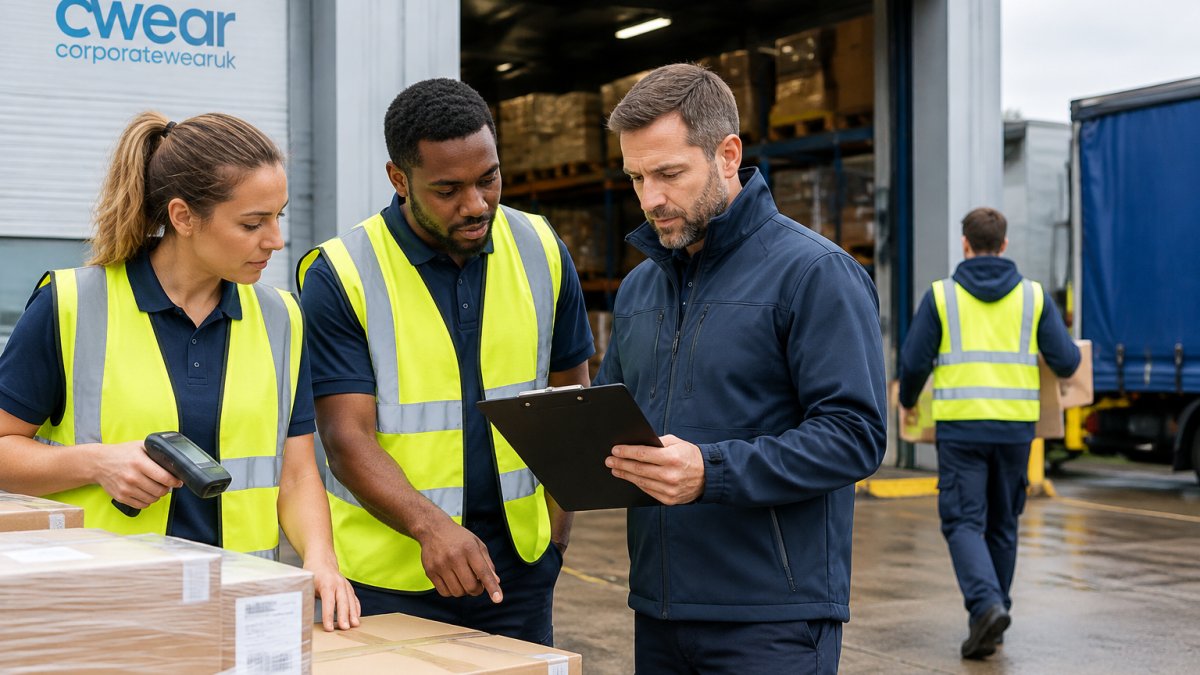
When you specify garments, check fabric weight and wash performance rather than just colour options. Heavier polycotton polos hold their shape through repeated industrial washes, and fleece-backed softshells add warmth without restricting movement. Our durable branded uniforms for warehouse staff guide covers fabric choice in more detail.
For teams that want to see the finished article, a printable safety softshell jacket gives you a clear idea of how hi-vis and branding combine, while a workwear polo shirt shows what an everyday branded option looks like.

Branding Quality: Embroidery and Printed Branding Across Both Suppliers
Branding quality is where cheap uniform orders usually fall apart. A logo that looks sharp on the first batch can shrink, crack or shift colour by the third reorder, and that inconsistency is visible to every customer who walks past your team.
When comparing suppliers, ask whether they keep your logo artwork on file for exact repeat orders and how they check colour matching between batches.
Warehouse Workwear and PPE: What Each Supplier Covers
Logistics workwear is not just about looking consistent. Warehouse staff need protection, and a supplier that treats PPE as an afterthought creates compliance headaches for whoever signs off on health and safety. The practical difficulty is that "logistics" covers several different risk profiles, and the PPE requirement changes with the role, the environment and the time of day.
Both suppliers list hi-vis clothing and safety gear.
Start by separating roles rather than buying one kit for everyone:
- Warehouse operatives working around moving vehicles and forklifts typically need high-visibility upper garments and, depending on the site risk assessment, high-vis trousers. Safety footwear to EN ISO 20345 is standard, and gloves should match the handling task.
- Drivers leaving the cab on loading bays or roadside need high-vis that meets the visibility requirement for the road or site, plus weatherproof outer layers. A branded polo alone is not sufficient once they step outside.
- Supervisors and visitors moving between zones often need the same baseline hi-vis as operatives, with a different colour or trim to distinguish them where site rules require it.
- Customer-facing staff in a reception or dispatch office may only need a branded polo or softshell, but check whether they cross the yard at any point.
When you compare quotes, check that each item meets the relevant standard. Safety footwear should conform to EN ISO 20345, and hi-vis garments should meet the visibility requirements for your site. Ask for certification details with the quote, not after delivery.
Watch out: ordering hi-vis by colour alone without confirming the retroreflective tape specification and garment class can leave you with kit that fails a site audit even though it looks correct in a photograph.
Use this checklist when specifying a logistics kit:
- Hi-vis vest or jacket per operative, with certification supplied
- Hi-vis trousers where the risk assessment requires lower-body visibility
- Safety footwear to EN ISO 20345
- Gloves suited to handling tasks
- Weatherproof outer layer for outdoor work
- Branded polo or T-shirt for indoor shifts
- Role identifier (colour or trim) for supervisors where site rules require it
If you want to benchmark these two against a wider field on safetywear coverage, our guide to custom uniform providers for logistics companies compared puts more suppliers side by side.
Company Uniform Packages for Employees: What's Included and What It Costs
Package pricing is the hardest part of comparing these two suppliers, because neither publishes a simple all-in rate. Workwear pricing is often built from a per-garment price plus decoration, setup and carriage, so compare the full cost rather than the headline rate.
Build your own comparison using a total cost of ownership calculation:
Total cost per employee = (garment cost × number of items) + (decoration cost × logo positions) + setup fee + carriage, divided by headcount
Run that formula against both quotes for a 20-person warehouse team and the gap usually appears in decoration and setup, not the garments themselves. A worked example makes the point: if a polo is quoted at £8 per unit but embroidery adds £3 per logo position, setup is £40 and carriage is £25, the effective cost per polo on a 20-unit order is £12.25 before any reorder.
Beyond the arithmetic, ask both suppliers the same operational questions and compare the answers in writing:
- Minimum order quantities. Confirm the minimum per garment and per decoration method. A low garment minimum can still be defeated by a high embroidery minimum.
- Sample availability. Ask whether a plain sample and a decorated pre-production sample are available, and whether the sample cost is credited against the full order.
- Repeat-order consistency. Ask whether your logo artwork, thread colours and print settings are kept on file so a reorder in six months matches the first batch.
- Size ranges. Confirm the size range per garment, including larger sizes, and whether size surcharges apply.
- Lead times. Get the standard lead time and the lead time for a repeat order, which is often shorter but not always.
- Split-site and urgent orders. Ask how the supplier handles delivery to multiple sites and what happens to lead time and carriage on an urgent top-up order.
Watch out: comparing quotes on garment price alone can make a supplier with a higher unit price but waived setup and included carriage look more expensive than it is, so always normalise to cost per employee for the first order and the likely reorder.
If you are weighing up whether branded clothing earns its budget at all, our article on whether branded clothing improves team cohesion looks at the evidence.
Workwear Supplier Reviews: What Buyers Actually Report
The most useful thing you can do is read reviews for the specific scenario you are buying for. A review from a small retail team tells you little about how a supplier handles a 200-person logistics rollout with multiple sites and repeat orders.
When you speak to either supplier, ask directly:
- What is your actual turnaround time, and what happens if you miss it?
- How do you handle sizing for bulk orders to avoid returns?
- Will embroidery quality stay consistent across repeat batches?
- Are setup fees and carriage included in the quoted price?
A supplier that answers these clearly, in writing, is worth more than one with a longer catalogue and vaguer promises.
Get a Quote for Your Logistics Team's Workwear
Comparing suppliers is the easy part. Getting a consistent, durable, properly branded uniform onto every member of a logistics team, on time and at a predictable cost, is where most buyers run into trouble.
At Corporatewear UK, we have supplied branded workwear and uniforms since 1996, with over 25 years of experience. We offer a price match guarantee, a 5-7 day turnaround, same day artwork approval, and expert embroidery and printing services.
Get started with Corporatewear UK and equip your logistics team in durable, custom-branded clothing that holds up on the floor and looks right in front of your customers.
Frequently Asked Questions
Which is better for logistics workwear: Perfectworkwear or Brandableclothing?
Neither wins outright. For logistics workwear specifically, judge both on hi-vis compliance, fabric durability, minimum order quantities and turnaround. Ask each supplier for a sample garment, a written quote with all setup fees included, and a delivery date you can hold them to before committing.
What should logistics teams look for in a workwear supplier?
Start with the range: polos, T-shirts, hoodies, jackets and hi-vis clothing that meet visibility requirements, plus safety footwear and gloves. Check fabric quality and durability for industrial washing, confirm embroidery and printed branding stay consistent across repeat orders, and get the minimum order, turnaround and delivery terms in writing. A supplier that cannot show you a sample and a fixed quote before ordering is a risk.
Can Perfectworkwear and Brandableclothing provide branded uniforms?
The questions that matter are consistency across batches, artwork approval speed and whether setup costs are disclosed upfront. Request a sample of your logo on the actual garment you plan to order, and confirm in writing that repeat orders will match the first batch in colour, placement and stitch quality.
What should a company uniform package include for employees?
A practical package for warehouse and transport roles covers polos or T-shirts, a mid-layer such as a fleece or softshell, hi-vis clothing where visibility is required, and safety footwear. Add gloves and weather protection for outdoor work. Price each item before you commit: for example, hi-vis overtrousers at £10.71, a microfleece at £15.21 and a softshell at £22.86 give you a baseline to compare supplier quotes against.
How can a business check workwear supplier reviews before ordering?
Read reviews for patterns rather than star ratings, paying attention to the points that matter most for your own rollout. Ask the supplier for references from similar-sized operations, and test them with a small first order before rolling out to a full team. A supplier confident in its turnaround and quality will welcome a trial batch.


