


Ripstop wins on tear resistance and packability, so it suits high-mobility, tear-prone roles like tactical work and outdoor labour. Twill wins on abrasion resistance and appearance, so it suits everyday uniforms, hospitality and customer-facing roles. The difference comes down to weave geometry: ripstop’s reinforced grid arrests small tears before they spread, while twill’s diagonal weave spreads surface wear evenly. The sections below cover the technical basis and fabric-by-role recommendations.
TL;DR:
- Ripstop fabric offers twice the tear resistance of twill, making it ideal for snag-prone environments such as construction or outdoor labor.
- Twill surpasses ripstop in abrasion resistance, withstanding over 50,000 Martindale cycles, suitable for uniforms exposed to constant rubbing or kneeling.
- Ripstop’s open structure provides better breathability and faster drying times, critical for outdoor or high-mobility roles, whereas twill is heavier and less breathable.
- The choice of fiber affects performance: nylon and polyester improve drying and color retention in ripstop, while cotton enhances comfort in twill but reduces durability.
- Matching fabric to real failure modes is key; ripstop prevents catastrophic tears, while twill allows for predictable, gradual degradation.
Table of Contents
- Ripstop vs twill: how the weaves are actually built
- Tear resistance, abrasion, breathability and weight compared
- Choosing ripstop or twill for common workwear roles
- Care, finishes and repairs that extend fabric life
- Why Corporatewear UK’s fabric experience matters here
- The trade-off nobody puts on a spec sheet
- Order the right fabric through Corporatewear UK
- Sources
- FAQ
Ripstop vs twill: how the weaves are actually built
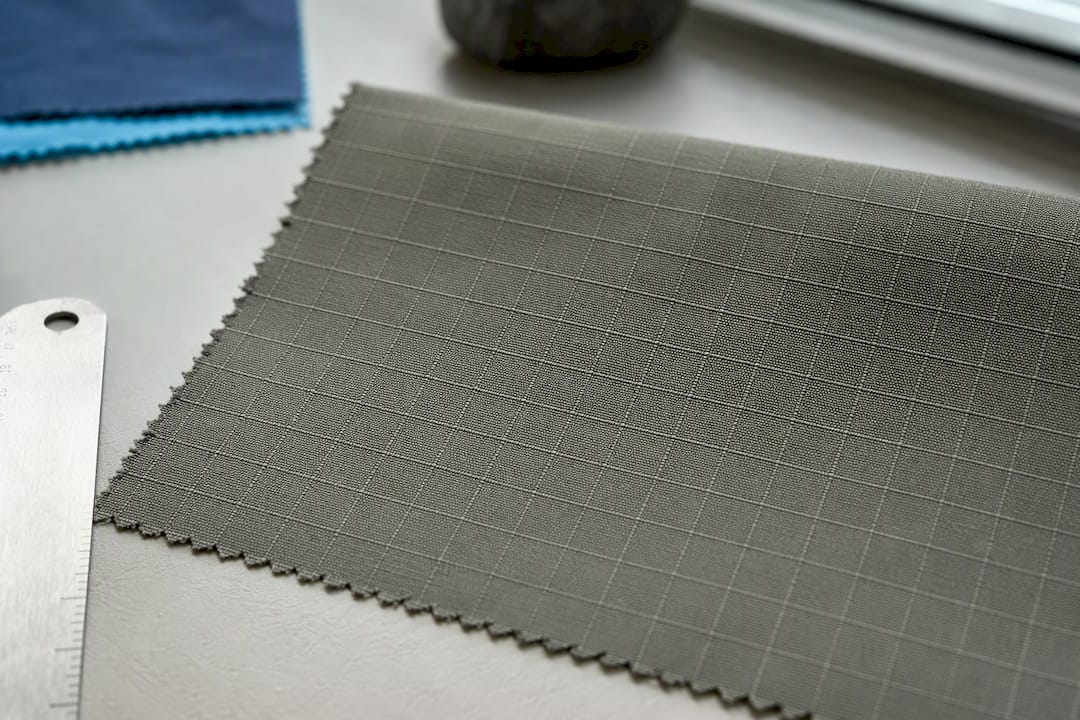
Ripstop gets its name from what it does: stop a rip in its tracks. Thicker reinforcement yarns run through the base weave at regular intervals, commonly every 5–8 mm, creating a visible grid. That grid intercepts a tear before it can travel across the whole panel. Military-specification NyCo ripstop, a nylon-cotton blend, typically weighs 200–230 g/m², which is light for the protection it delivers.
Twill works differently. Instead of a reinforcement grid, the weft yarn passes over and under the warp in a staggered 2/1 or 3/1 pattern, producing the diagonal rib you see on denim or chino cloth. That diagonal structure spreads stress across more contact points, which is why twill resists surface scuffing so well even though it has no built-in tear-arrest mechanism.
Fibre choice changes both fabrics considerably:
- Nylon and polyester speed up drying and hold colour better through repeated washing, which is why most technical ripstop leans synthetic.
- Cotton improves the hand and feel against skin but increases shrinkage risk and slows drying, which is why classic twill uniforms are often cotton or cotton-rich.
- NyCo blends (nylon-cotton) combine the tear arrest of nylon with the comfort of cotton, explaining why military and field uniforms favour this combination over pure synthetics.
- PolyCo blends (polyester-cotton) sit in the middle ground for everyday uniform twill, trading a little softness for easier care.
Grammage tells you a lot before you even touch a swatch. Lightweight ripstop for summer or active roles can sit well under 150 g/m², while heavier combat-grade ripstop climbs past 200 g/m². Twill for workwear trousers or jackets typically runs from 200 g/m² for lighter shirting weights to well over 300 g/m² for heavy-duty drill trousers.
Tear resistance, abrasion, breathability and weight compared
Procurement decisions usually hinge on one question: what is this garment most likely to fail from first? Tearing and abrasion are different failure modes, and the two weaves are engineered for opposite priorities.
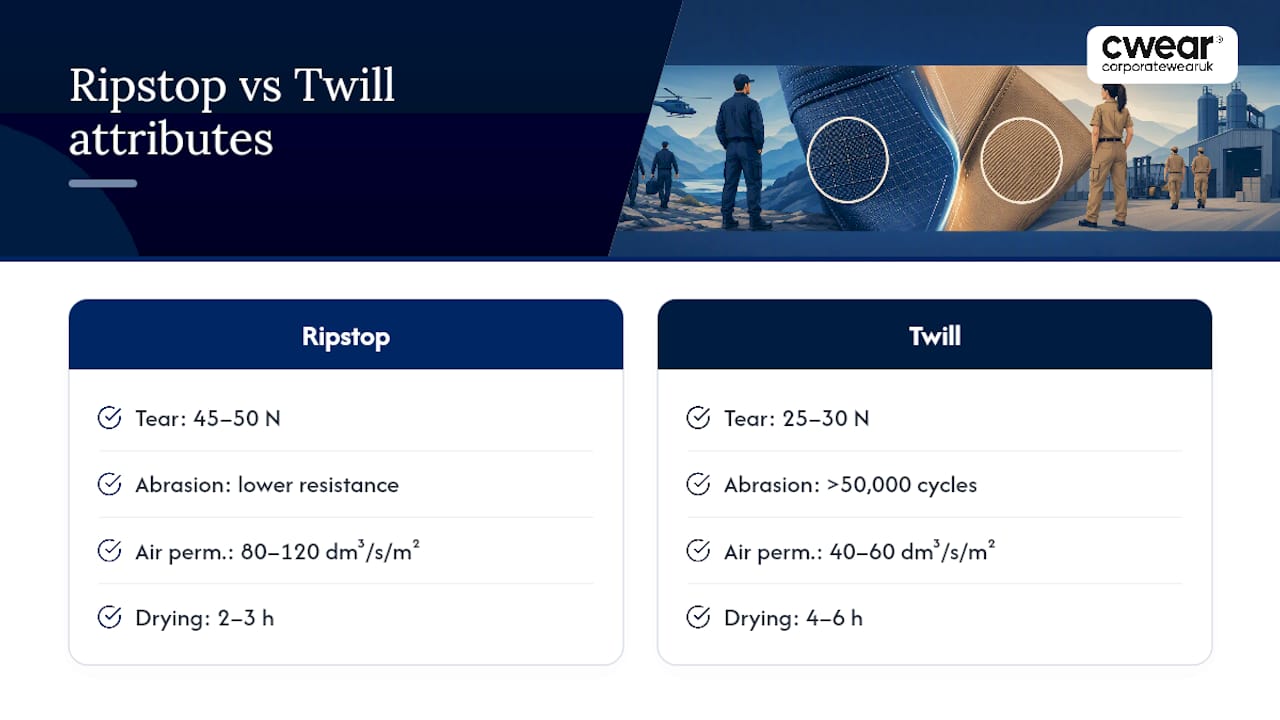
Tear resistance is ripstop’s home ground. Comparative testing using the Elmendorf tear method shows ripstop typically records 45–50 N against cotton twill’s 25–30 N, roughly double the resistance to a tear propagating once it has started. That gap matters most on snag-prone sites: scaffolding, chain-link fencing, brambles, sharp edges on machinery. A small nick in twill can run the length of a sleeve; the same nick in ripstop usually stops at the nearest reinforcement thread. Standardised tear testing generally follows methods like ASTM D1424, and researchers have modelled how yarn and weave variables predict that resistance, confirming that weave geometry, not just fibre strength, drives the result.
Abrasion resistance flips the advantage to twill. Martindale testing, the standard method for rubbing-wear durability, puts many twill weaves comfortably past 50,000 cycles, with NyCo and specialist twill blends running even higher. That figure translates to daily reality: knees that brush against ladders, forearms that rest on counters, seats that grind against van interiors all week. Ripstop’s open grid structure, while excellent against sharp tears, doesn’t resist that grinding, repetitive friction as well.
Statistic callout: Twill weaves commonly exceed 50,000 Martindale cycles before visible wear, while ripstop shows its strength in Elmendorf tear values roughly double that of cotton twill. Neither number makes one fabric universally “stronger” — they measure different threats.
Breathability and drying favour ripstop again, mostly because it’s woven from finer synthetic yarns with a more open structure. Reported air permeability for ripstop averages 80–120 dm³/s/m² against twill’s 40–60 dm³/s/m², and drying times follow the same pattern: roughly 2 to 3 hours for ripstop versus 4 to 6 hours for twill under equivalent conditions. For anyone doing shift changes or working outdoors in variable weather, that difference decides whether a garment is dry for the next shift.
Weight and packability split along the same lines. Lightweight ripstop packs down small and adds little heat burden, which is why it dominates summer and high-mobility gear. Heavier twill carries more bulk but delivers the surface durability and structured drape that a smart uniform needs.
If a garment’s biggest daily threat is snagging or tearing, specify ripstop. If the threat is constant rubbing, kneeling or a smart finished look, specify twill.
Choosing ripstop or twill for common workwear roles
Matching fabric to job function prevents both under-specifying (garments that fail early) and over-specifying (paying for performance nobody needs). Here’s how the two weaves map onto common procurement categories.
- Harsh outdoor labour (construction, groundworks, forestry): ripstop or a heavyweight NyCo ripstop blend. Tear risk from branches, fencing and rough surfaces outweighs abrasion concerns, and guidance for tear-prone, high-mobility roles consistently points to ripstop here.
- Tactical and field roles (security patrol, field engineers): NyCo ripstop again, balancing tear arrest with enough abrasion resistance for crawling, kneeling and equipment contact.
- Summer and active roles (delivery, warehouse picking in warmer months, outdoor events): lightweight synthetic ripstop. Lighter ripstop variants reduce heat burden and improve packability, which matters more than tear resistance in most indoor-adjacent active jobs.
- Warehouse and indoor operational roles: mid-weight twill. Abrasion from racking, pallets and repetitive movement is the dominant threat, not tearing.
- Hospitality and customer-facing uniforms: twill, almost without exception. Its texture and ability to hide stains and everyday marks makes it the standard choice for front-of-house staff who need to look presentable through a full shift.
Care, finishes and repairs that extend fabric life
Washing habits differ sharply between the two fabric families. Cotton twill shrinks if washed too hot and dries slowly, so a 30 to 40°C wash with a low tumble setting protects both fit and colour. Synthetic ripstop tolerates warmer washes better and dries fast on its own, so it rarely needs a tumble dryer at all.
Finishing treatments change how each fabric behaves in the field:
- DWR (durable water repellent) finishes cause water to bead and roll off without blocking the weave’s breathability, unlike a true waterproof membrane or coating, which stops water but also traps moisture inside.
- FR (flame-retardant) finishes are applied mostly to twill and heavier canvas-style fabrics for roles near heat or sparks, and any FR-treated garment should only be laundered with detergents that don’t strip the finish, following the supplier’s care guidance.
- Anti-soil finishes on twill reduce how visibly dirt clings to the surface, extending the time between washes for customer-facing roles.
Repairs also diverge. A tear in ripstop usually needs only a patch or a line of stitching along the nearest reinforcement thread, because the grid has already contained the damage. Twill tears or wears through more gradually, so reinforcing high-friction zones like elbows and knees before damage appears is the more cost-effective approach.
Pro Tip: Ask your supplier whether a garment’s DWR finish is reapplied after washing or factory-set for life. A factory-set finish that fades after a dozen washes will leave a “waterproof” jacket performing like ordinary fabric within a season.
Why Corporatewear UK’s fabric experience matters here
Corporatewear UK has specified workwear fabric across construction, hospitality, education and security sectors for more than 25 years, including in-house embroidery and printing capability that depends on knowing how a weave behaves under a needle. That practical grounding, not just lab figures, shapes which fabrics get recommended for which role.
Within the current catalogue, the Dual-fabric sports jacket pairs contrasting fabric zones so high-wear panels get abrasion resistance while lighter sections stay breathable, a direct application of the twill-versus-ripstop trade-off. The Kyoto jacket leans on a twill-style construction for a tailored, customer-facing finish. The Endurance softshell uses a blended, weather-resistant build where ripstop-like durability supports outdoor and active use.
The trade-off nobody puts on a spec sheet
Most fabric comparisons treat ripstop and twill as if one is simply “better”, ranked by a single durability score. That framing misses the point. Tear resistance and abrasion resistance are not the same axis, and specifying the wrong one for the job means paying for protection that never gets used while leaving the actual weak point unprotected.
The overlooked factor is how fast a fabric fails, not just how hard it fights back. Twill degrades slowly and visibly, giving you time to plan a replacement order before a uniform actually lets someone down. Ripstop tends to hold firm until a specific event, a snag or puncture, then fails suddenly at that single point. For procurement, that means twill suits predictable replacement cycles, while ripstop suits roles where a single catastrophic tear is the real risk you’re managing against.
If you take one thing from this comparison, prioritise matching the fabric to the actual failure mode your team faces on site, not to whichever fabric sounds more rugged on paper.
— Vinay
Order the right fabric through Corporatewear UK
This supplier gives procurement managers a direct route from fabric decision to finished uniform, without the guesswork of sourcing swatches from multiple suppliers. Every product page states the build so you can match ripstop-style durability or twill-style presentation to the role before you commit to an order.

Bulk pricing applies across the catalogue, and designs typically go through artwork mockup approval before production starts, so embroidery placement and print detail are confirmed on the actual fabric rather than guessed at. Showroom visits may be available to handle the cloth in person, useful when weighing abrasion resistance against packability for a specific team. Eco-friendly options may be available for businesses that need sustainability credentials alongside durability. Browse the Dual-fabric sports jacket for mixed-use durability, the Kyoto jacket for a smarter twill-led finish, or the Endurance softshell for weather-resistant outdoor roles, and request a quote to see bulk pricing for your team size.
Sources
- Camouflage uniform fabrics: Ripstop, Twill, and NyCo comparison | Raff Military Textile
- Ripstop vs Twill Fabric: Key Differences & Benefits | Propper
- Ripstop vs Twill vs Canvas: Which Fabric Is Best for Workwear?
- Academia
FAQ
What are the disadvantages of ripstop fabric?
Ripstop typically has lower abrasion resistance than twill, so it can show surface wear faster in high-friction roles, and its grid texture can make fine embroidery detail look less even than on a smoother twill surface.
What are the disadvantages of twill fabric?
Twill lacks a built-in tear-arrest structure, so a snag or puncture can spread further than it would on ripstop, and cotton twill dries more slowly, taking roughly 4 to 6 hours compared with ripstop’s 2 to 3.
Is twill too hot for summer?
Cotton twill is generally warmer and slower to dry than lightweight synthetic ripstop, making it less suited to hot, active summer roles unless it’s woven in a lighter, breathable weight.
Is ripstop better than cotton?
Ripstop generally outperforms plain cotton twill on tear resistance and drying speed, but pure cotton twill still wins on softness and abrasion resistance, so the better choice depends on which failure risk matters most for the role.
Should I choose ripstop or twill for branded uniforms?
Twill usually suits branded, customer-facing uniforms best because it drapes cleanly and takes embroidery with less puckering, while ripstop suits branded outdoor or tactical garments where tear resistance matters more than a tailored finish.


