


A waterproof rating is the hydrostatic head measured in millimetres, the depth of a water column a fabric resists before it leaks. As a rule of thumb, 10,000mm handles commuting and day hikes in steady rain, while 15,000 to 20,000mm-plus suits sustained exposure on the hill or the site. None of that matters without breathability: a high mm rating with poor moisture vapour transmission just traps sweat instead of rain.
TL;DR:
- A waterproof rating of 10,000mm handles the average UK rain, but construction features like seam taping and waterproof zips are crucial for actual performance.
- Fabric construction, such as 2-layer versus 3-layer, significantly impacts durability and how well a jacket maintains its waterproofing over time.
- Breathability, measured by MVTR, is vital; a high waterproof rating with poor breathability will trap sweat, making the jacket uncomfortable during physical activity.
- For prolonged outdoor work or mountaineering, a rating of 15,000 to 20,000mm with high MVTR enables better moisture management and protection.
- Matching waterproof and breathability levels to the activity ensures more effective protection and comfort, preventing over-specifying and unnecessary weight.
Table of Contents
- What is a waterproof rating (hydrostatic head)?
- How are waterproof ratings measured (the hydrostatic head test)?
- What the numbers mean in real-world use: practical rating bands
- Waterproof vs water-resistant vs water-repellent
- Breathability and MVTR: what the numbers mean and how to interpret them
- Finding the balance: choosing waterproofness and breathability for your activity
- 2-layer, 2.5-layer and 3-layer constructions and what they mean for use
- How to maintain and restore a waterproof jacket
- Why understanding these numbers changes what you buy
- Kitting out your team for wet-weather work
- Sources
- FAQ
What is a waterproof rating (hydrostatic head)?
Hydrostatic head works on a simple principle: a section of fabric sits under a column of water, and the column keeps rising until moisture forces its way through. The height reached, recorded in millimetres, becomes the fabric’s waterproof rating. A fabric rated at 10,000mm theoretically holds back a 10-metre column of water before failing.
The number describes the fabric itself under static, controlled pressure. It doesn’t capture what happens when a rucksack strap presses down on a shoulder seam for six hours, or when wind drives rain sideways into a hood. Kneeling, crouching, and pack pressure all create localised forces the test never simulates, which is why a jacket can leak at points well below its rated figure
Construction elements matter just as much as the base fabric number:
- Seam taping, since untaped stitching lets water straight through regardless of the mm rating
- Zip type, with waterproof or storm-flap zips closing an obvious weak point
- DWR (durable water repellent) coating, which keeps the outer face from “wetting out” and dragging performance down
- Panel placement, since shoulders and hoods face more direct pressure than a hem
How are waterproof ratings measured (the hydrostatic head test)?
Laboratories follow a standardised process, most commonly the one set out in EN ISO 811, to keep results comparable across manufacturers.
- A fabric sample is clamped tightly over a test chamber, with no folds or creases that could skew the result.
- Water pressure beneath the sample increases at a controlled rate.
- Technicians watch the reverse face for the appearance of water droplets, the point taken as failure.
- The height of the water column at that moment becomes the recorded hydrostatic head, usually as an average across several samples to smooth out variance.
Temperature and the rate of pressure increase both influence the final figure, so two labs testing an identical fabric can report different numbers. That’s one reason a jacket described as “20k waterproof” by one brand isn’t automatically equivalent to another brand’s 20k claim, and it’s part of why mm figures alone don’t equate to any single proprietary membrane technology, GORE-TEX included. Treat published figures as a guide to relative performance within a range, not an exact promise of dry kneeling in a puddle for an hour.
What the numbers mean in real-world use: practical rating bands
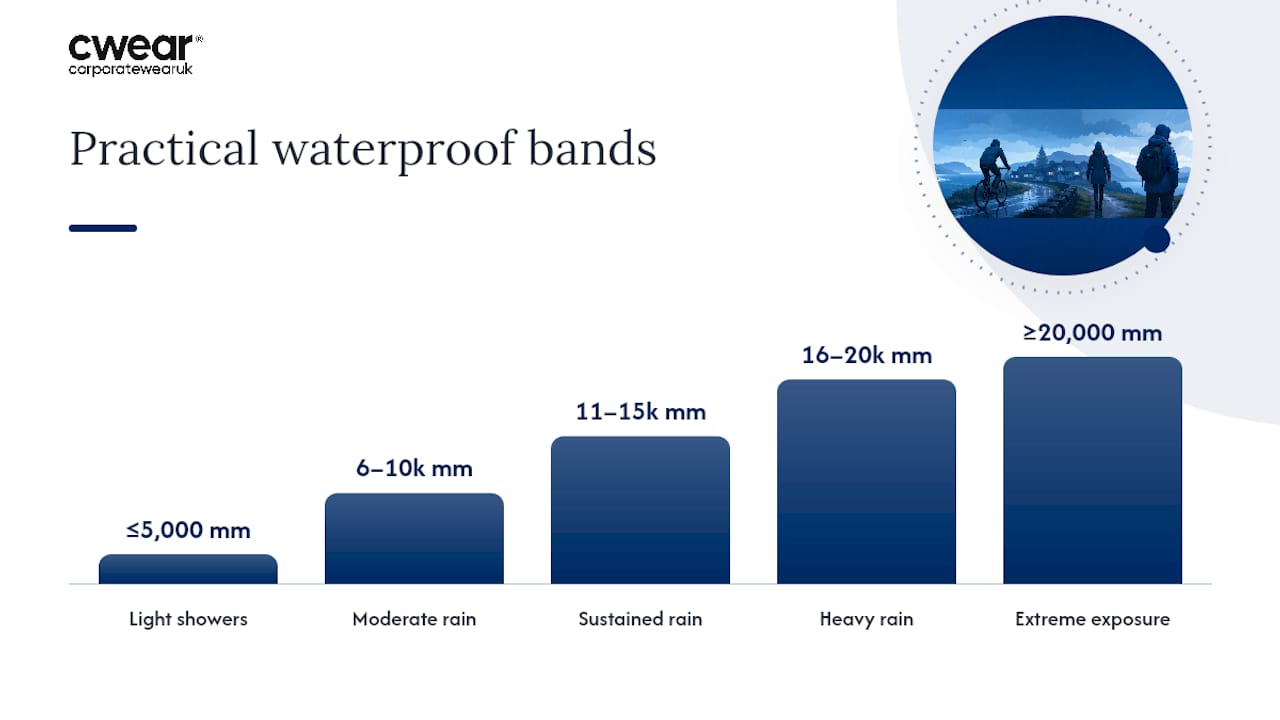
Manufacturers group hydrostatic head figures into rough performance bands, and matching one to what you’re actually doing outdoors matters more than chasing the highest number on the label.
- Up to 5,000mm: light showers and short exposure. Fine for a dash between the car and the office, not for a wet afternoon outside.
- 6,000 to 10,000mm: moderate rain over several hours. This is the workhorse band for commuting, dog walking and day hikes.
- 11,000 to 15,000mm: sustained rain with some pack or knee pressure. Suited to longer walks and light hillwalking.
- 16,000 to 20,000mm: heavy, persistent rain and rough handling. Common on serious hiking and mountaineering shells.
- 20,000mm and above: extreme, prolonged exposure. Expedition and severe-weather kit, often at a premium price and with stiffer, heavier fabric.
Pro Tip: A 20,000mm jacket that’s had its DWR coating wear off can perform worse in the field than a fresh 10,000mm jacket, because water sitting on the outer face (“wetting out”) blocks breathability and eventually seeps through seams under pressure.
Practical guidance built around these bands treats 10,000mm as the sensible baseline for regular UK weather, moving up only when the activity genuinely demands it. Higher ratings tend to mean stiffer fabric, more weight, and a higher price tag, none of which helps someone who mostly walks between a van and a site cabin. Match the rating to the job, not the other way round.
Waterproof vs water-resistant vs water-repellent
These three terms get used loosely, but they describe genuinely different levels of protection.
- Waterproof means a membrane and taped seams tested to a specific hydrostatic head, holding out sustained rain and pressure.
- Water-resistant describes a tighter weave or light coating that slows moisture penetration, fine for drizzle but not for a downpour.
- Water-repellent refers to a surface treatment, almost always DWR, that makes water bead and roll off rather than soak in.
DWR sits on the surface of even the most technical waterproof shells, so it’s not a separate budget option, it’s a maintenance issue. Once it wears thin from abrasion, washing, or general use, the fabric wets out and feels damp even though the membrane underneath is still intact. Reproofing restores that surface behaviour rather than fixing the waterproof rating itself, which is a fabric property that doesn’t change with age unless the membrane is physically damaged.
Choose water-repellent-only kit for short exposure and dry, active use. Reach for a fully waterproof, taped-seam garment whenever rain is prolonged or heavy, or whenever the job means kneeling, crouching, or carrying weight against wet fabric for hours at a time.
Breathability and MVTR: what the numbers mean and how to interpret them
Moisture Vapour Transmission Rate (MVTR) measures how much sweat vapour a fabric lets escape, expressed in grams per square metre over 24 hours (g/m²/24h). A higher MVTR figure means better breathability, which matters because a jacket that’s perfectly waterproof but poorly breathable simply traps perspiration instead of rain. You end up just as wet, from the inside.
Rough bands to work from:
- Under 5,000g/m²/24h: minimal breathability, suited to low-exertion, static use such as standing on a site perimeter.
- 5,000 to 10,000g/m²/24h: moderate, workable for walking and light physical work.
- 10,000 to 20,000g/m²/24h: good breathability for sustained activity like hiking or manual labour.
- 20,000g/m²/24h and above: high-performance fabric aimed at aerobic activity such as climbing or fast hiking.
Pro Tip: Never compare MVTR numbers between brands at face value. Lab conditions, temperature and humidity all affect the reading, so treat MVTR as a way to compare a manufacturer’s own product range, not an absolute figure that transfers cleanly across different testing houses.
Finding the balance: choosing waterproofness and breathability for your activity
The right combination depends on how hard you’re working and how long you’re out, not on whichever jacket has the biggest number on the swing tag.
- Commuting or dog walking: 5,000 to 10,000mm waterproofing paired with moderate MVTR is plenty, since exposure is short and exertion is low.
- Day hiking: aim for 10,000 to 15,000mm with good breathability, since you’re moving steadily and generating body heat for hours.
- Multi-day trekking: 15,000 to 20,000mm with high MVTR handles repeated wetting, pack pressure, and sustained effort.
- Skiing: 15,000mm-plus with strong breathability copes with driven snow, sitting on lifts, and high-output descents.
- Heavy site or outdoor work: 20,000mm-plus with robust construction matters more than breathability figures, given the abrasion and prolonged exposure involved.
Higher specifications on both fronts usually cost more, weigh more, and pack down less easily, so there’s a genuine trade-off rather than a simple “buy the best” answer. Before buying, run through a short checklist: taped seams throughout, waterproof-rated zips, an adjustable hood that moves with your head, underarm pit zips for venting, and a DWR coating that’s still beading water rather than soaking it in.
2-layer, 2.5-layer and 3-layer constructions and what they mean for use
Layer count describes how the waterproof membrane is bonded to other fabric, and it changes how a rating actually feels on your body.
- 2-layer: an outer fabric bonded to a membrane, with a separate hanging liner inside for comfort. Common on budget and general-use jackets, though the liner adds bulk and dries slowly.
- 2.5-layer: an outer fabric with a membrane and a thin protective print or coating instead of a full liner. Lighter and more packable, but the coating wears faster under heavy abrasion.
- 3-layer: outer fabric, membrane, and inner liner all bonded into a single fabric. More durable and better at managing moisture against the skin, which is why most premium hiking and mountaineering shells use it.
A 20,000mm rating on a 3-layer fabric will typically hold up longer in the field than the same figure on a 2-layer jacket, because the bonded liner protects the membrane from abrasion and pack rub. Construction, not just the mm number, decides how a rating actually performs after a few months of real use.
How to maintain and restore a waterproof jacket
A neglected waterproof jacket loses performance long before the membrane itself fails, and most of that loss is preventable.
- Wash regularly with a technical cleaner designed for waterproofs, never standard fabric detergent, which leaves residue that blocks the membrane’s pores. Aim for every few weeks of regular use, more often if the jacket sees mud or sweat heavily.
- Renew the DWR coating once water stops beading on the surface and starts soaking in. Spray-on or wash-in reproofing products restore this, usually followed by a spell in a warm tumble dryer or with an iron on a low setting to reactivate the treatment.
- Repair small damage promptly: reseal peeling seam tape with a seam-sealant pen, and replace failing zip pulls or sliders before water starts tracking through the gap.
- Watch for membrane fatigue: persistent internal dampness even after reproofing, or a jacket that feels clammy regardless of DWR renewal, usually signals the membrane itself has worn out rather than just the surface coating.
Pro Tip: Test DWR quickly by splashing water on a dry sleeve. If it beads and rolls off, the coating’s fine. If it darkens and soaks in, it’s time to reproof, regardless of how new the jacket looks.
Why understanding these numbers changes what you buy
Most people buying outdoor or work clothing default to picking the highest waterproof number on the label, assuming it’s the safest choice. That instinct is understandable, but it’s usually the wrong call, and it’s the single most common mistake I see in how these garments get chosen.
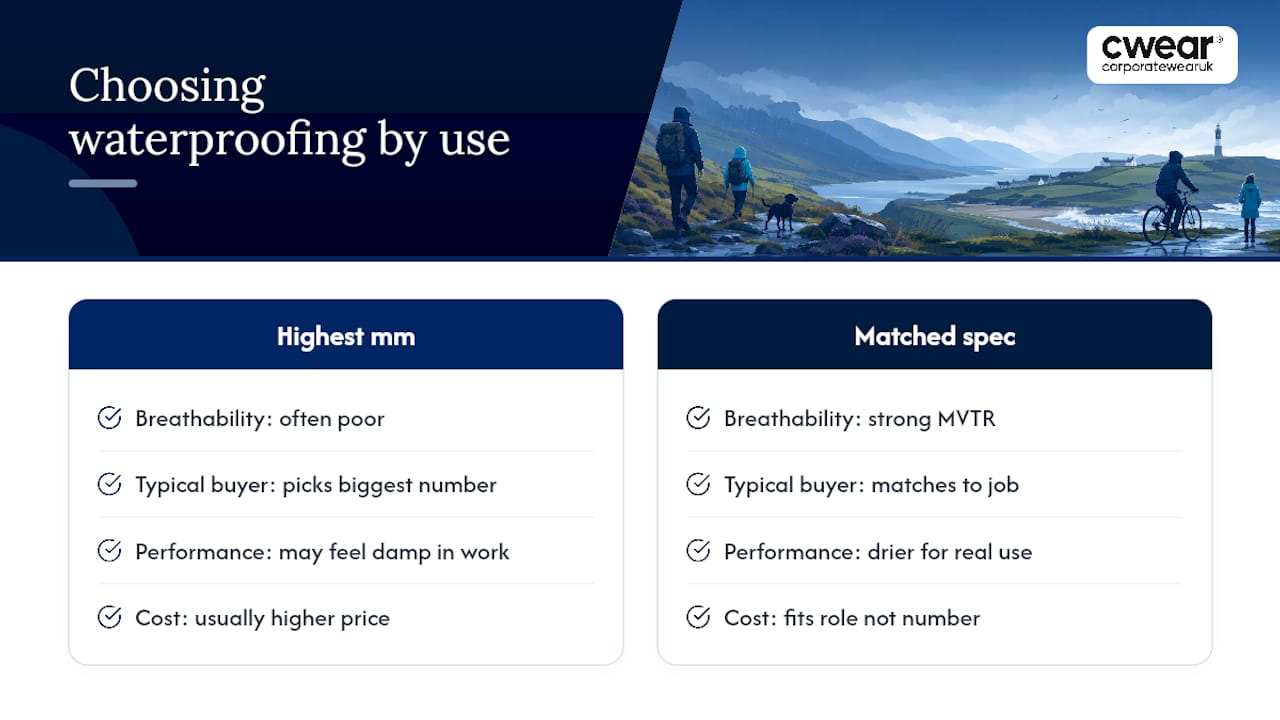
A 20,000mm jacket with poor breathability, worn by someone doing physical work in mild rain, often performs worse in practice than a well-built 10,000mm garment with strong MVTR. The wearer ends up damp either way, they just paid more for the privilege. The mm figure gets all the attention on a swing tag because it’s a single, easy number to compare. Breathability, seam quality, and DWR condition are harder to market but do more of the actual work in daily use.
Over many years of supplying workwear across construction, hospitality, education and security, the pattern holds regardless of sector: garments chosen for the job they’re actually doing outperform garments chosen for the biggest number on the spec sheet. A site supervisor standing in drizzle for short spells needs something different from a groundworker doing physical labour in sustained rain, even though both might reach for “a waterproof jacket” as the request. A product range built around that distinction matches construction and rating to genuine use cases rather than treating waterproofing as a single, one-size-fits-all spec.
— Vinay
Kitting out your team for wet-weather work
There are options for workwear that match the ratings and constructions covered above, rather than a single generic “waterproof jacket” line. For staff who move between vehicles, sites, and weather all day, the Endurance softshell gives active teams flexible, water-resistant protection without the bulk of a full shell.

Where sustained rain is the bigger risk, the Kyoto jacket offers all-weather outer protection suited to staff working outdoors for extended periods, in line with the higher mm bands discussed earlier. For teams needing visibility alongside wet-weather protection, the Safety high-viz trousers pair waterproofing with the reflective standards site work demands. Every garment can carry embroidered or printed branding as part of the order, so protective kit doubles as visible brand identity on site. Businesses fitting out crews across construction, hospitality, education or security can request a quote or arrange a showroom visit through Cwear’s order portal to match garments to their teams’ actual conditions rather than guessing from a spec sheet.
Sources
For readers who want the underlying technical detail rather than the practical summary above, a handful of sources cover the testing methodology properly.
FAQ
What is a good waterproof rating?
For general UK weather, 10,000mm is a solid practical minimum for commuting and day hikes, while 15,000 to 20,000mm suits sustained exposure on longer trips or outdoor work.
Is 20k waterproof as good as GORE-TEX?
A 20,000mm rating measures water-pressure resistance only, and it doesn’t automatically match the full performance of a proprietary membrane like GORE-TEX, since breathability and construction quality also shape real-world results.
Is IP67 or IP68 better waterproof?
IP68 offers greater protection than IP67 under the IEC ingress-protection scale, but both codes apply to electronics, not clothing, since they measure immersion and dust resistance for enclosures, not fabric performance.
Is 20,000mm a good waterproof rating?
Higher waterproof ratings, such as those around 20,000mm, are suited to heavy, prolonged exposure, but real comfort depends also on strong breathability and quality construction like well-taped seams.
What waterproof rating do I actually need for work outdoors?
It depends on exposure and effort: light-duty roles with occasional showers manage fine on 6,000 to 10,000mm, while staff working outdoors all day in sustained rain need 15,000mm or higher, alongside a breathable construction like the ones used in Cwear’s Endurance softshell and Kyoto jacket.


