


Last Updated: November 2, 2026
Quick Summary
The best ljworkwear alternative for construction firms is a supplier judged on garment durability, UK compliance, branding consistency, sizing and fulfilment reliability rather than price alone. Compare quotes on the same specification, including branding, delivery and setup fees, and score total cost of ownership over a year. Corporatewear UK has supplied branded workwear since 1996.
- Score suppliers on durability, compliance, branding, sizing and fulfilment before price.
- Confirm logo artwork and placement in writing before production begins.
- Ask for lead times in working days and whether branding is included.
- Compare total delivered cost on a realistic order, not headline garment price.
- Request samples and run a wash and wear test before committing.
Table of Contents
- What Construction Firms Should Demand From an LJ Workwear Alternative
- Construction Workwear Suppliers: What Separates a Good One From a Cheap One
- High Visibility Workwear for Construction: Getting the Standard Right
- Garments That Survive Site Conditions: Trousers, Bibs and Jackets
- Company Uniform Packages for Employees: Sizing, Branding and Repeat Orders
- Workwear Supplier Comparison: Pricing, Lead Times and Service
- Total Cost of Ownership: Why the Cheapest Quote Rarely Wins
- Requesting Samples and Building a Repeatable Order Process
- Frequently Asked Questions
What Construction Firms Should Demand From an LJ Workwear Alternative
Construction firms weighing up an ljworkwear alternative are not really shopping for garments. They are choosing a supply partner that keeps a site team kitted out, branded consistently and compliant, order after order.
Here is the uncomfortable truth most supplier guides skip: the cheapest quote and the best supplier are almost never the same company. Below, we break down the criteria that actually decide a workwear supplier and show you how to build a repeatable order process that survives its first winter.
The Criteria That Actually Decide a Supplier
A workwear supplier is a business that provides, brands and replenishes clothing for a workforce, not just a shop that sells garments. The criteria that separate a good one from a cheap one fall into five areas:
- Garment durability under site conditions and industrial washing
- Compliance with UK high-visibility and protective clothing requirements
- Branding consistency across repeat batches, especially logo embroidery
Most procurement teams score suppliers on price first and everything else second. Reverse that order and your total cost usually falls.
Construction Workwear Suppliers: What Separates a Good One From a Cheap One
A good construction workwear supplier is predictable; a cheap one is unpredictable, and unpredictability is what costs you money.
What separates them shows up in the details. A good supplier confirms logo setup and artwork approval in writing before production. It quotes realistic lead times rather than optimistic ones.
Health and Safety Executive guidance on workplace PPE makes clear that protective clothing has to be suitable for the risks and fit the wearer properly, which is a supplier conversation, not just a purchasing one.
The things to watch for in a cheap supplier:
- Vague lead times that slip once you have committed
- Logo embroidery that drifts in size or placement between batches
- No clear sizing process for bulk orders
High Visibility Workwear for Construction: Getting the Standard Right
High visibility workwear for construction must meet the right standard for the environment, and that standard should be written into your specification, not assumed. The useful part is knowing what to check and how to write it into a brief so a supplier cannot substitute a cheaper garment that looks similar but does not comply.
Which class you need depends on the risks on your site, the lighting conditions and the tasks being carried out, and that decision belongs with your health and safety lead.
Writing the Standard Into Your Supplier Brief
Agree the required class with your health and safety lead, then make it a line in every supplier brief.
Beyond the class itself, check reflective tape placement, how the garment holds up to industrial washing, and whether the fabric repels dirt.
For a deeper walkthrough of the standards and how they apply on site, our construction workwear guide covers hi-vis and site clothing requirements in more detail.
Checking Compliance Without Overclaiming
Compliance is a document trail as much as a garment. Keep the supplier's written confirmation, the garment labelling and any declaration of conformity on file, and check that the standard and class on the label match what you ordered.
General workwear, trousers, sweatshirts, jackets, is not automatically protective equipment and should not be described as such unless tested and certified for a specific hazard.
Garments That Survive Site Conditions: Trousers, Bibs and Jackets
Durability on site is a fabric-and-construction question, and the garments that last share the same traits: reinforced abrasion points and robust stitching.
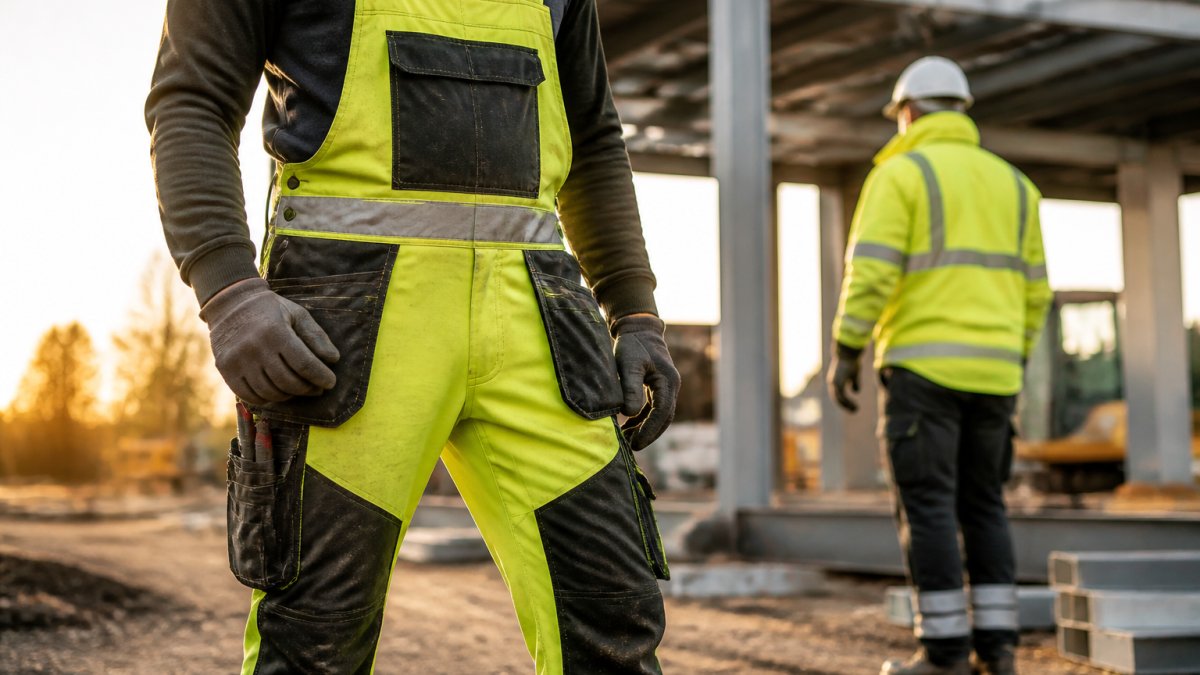
Work Trousers and Secure Tool Storage
Work trousers depend heavily on pocket design and fabric movement. Our Stretchchecker work cargo trousers are built with a stretch fabric for ease of movement, multiple pockets and a D-ring for hanging essentials, in a unisex design. For heavier demands, the PW3 Work Bib and Brace adds a double rule pocket, pre-shaped top-loading knee pad pockets, an easy-access thigh pocket and Oxford fabric reinforcement at key abrasion points.


Secure pockets are worth checking when you specify garments.
Waterproof Layers and Moisture Management
Waterproof layers need to do two jobs at once: keep rain out and let moisture escape. The Expert packable jacket II is a lightweight, waterproof, breathable jacket in a ripstop AquaDry membrane with a water-repellent finish, an adjustable hood and two zipped handwarmer pockets, and it packs into its own pocket. If you want to understand how waterproof ratings work before you specify jackets, our waterproof ratings explained guide breaks down what the numbers mean.
Company Uniform Packages for Employees: Sizing, Branding and Repeat Orders
Company uniform packages for employees succeed or fail on three things: sizing done properly, branding that stays consistent, and a repeat-order process you can actually run.
Branding is where consistency quietly breaks. Logo embroidery and printed logos should be approved as artwork once, then held to that standard across every batch.
For the practical side of sizing a whole team, our guide to managing bulk uniform sizing for your whole team walks through the process step by step.
- Agree the required hi-vis class with your safety lead
- Confirm logo artwork and placement in writing
- Collect sizes across the full team before ordering
Workwear Supplier Comparison: Pricing, Lead Times and Service
An ljworkwear alternative comparison should score pricing, lead times and service on the same sheet, because the cheapest line item rarely reflects the cheapest outcome.
Build a simple scoring table and weight the criteria that actually hurt when they fail. The table below is a starting point, not a finished scorecard; adjust the weights to match how your sites operate.
| Criterion | What to Check | Why It Matters |
|---|---|---|
| Garment durability | Reinforced seams, fabric weight, wash performance | Fewer replacements per year |
| Branding consistency | Artwork approval process, batch-to-batch control | Protects company branding |
| Sizing process | Bulk sizing support, returns handling | Fewer wasted garments |
| Lead time | Quoted and realistic delivery window | Keeps projects on schedule |
| Transparent pricing | Setup fees, branding costs, delivery charges stated upfront | No checkout surprises |
| Minimum order quantity | Per-garment and per-order minimums | Affects small-site and trial orders |
| Repeat-order cost | Whether branding setup is charged again | Changes the lifetime cost of a contract |
| Value for money | Cost per wear, not sticker price | Lower total cost of ownership |
What Transparent Business Pricing Actually Looks Like
A supplier serious about business customers will put the commercial terms in writing before you order. Ask for a written quotation that separates garment price from branding, delivery and any setup charge, and states the minimum order quantity for each garment and branding method.
On pricing, our own range gives you a benchmark: the Stretchchecker work cargo trousers at £27.00, the Hi-Vis Polycotton Service Bib and Brace at £34.11, the PW3 Work Bib and Brace at £41.04, the heavy-duty crew neck sweatshirt at £31.86 and the Expert packable jacket II at £53.91.

Lead Times, Delivery and Service
Ask for the lead time in working days, whether it includes branding, and what notice you get if a delivery is delayed.
Service is harder to score but easy to test. Ask how urgent orders are handled, what the returns process is for wrongly sized garments, and whether you get a named account contact.
If hidden fees are your concern, our guide on avoiding hidden uniform setup fees explains which charges to look for before you commit. For a broader comparison against other suppliers, our custom workwear suppliers comparison lets you benchmark options side by side.
Total Cost of Ownership: Why the Cheapest Quote Rarely Wins
Total cost of ownership is the real price of workwear: garment cost plus branding, replacements, returns, admin time and downtime when a delivery slips.
Run the calculations over a year, not an order. A garment that survives a full season of industrial washing and site wear reduces replacement frequency.
The hidden costs to weigh:
- Replacements from premature wear
- Returns from poor sizing
- Admin time chasing late deliveries
Value for money is cost per wear across the garment's usable life, not the number on the quote.
Requesting Samples and Building a Repeatable Order Process
Samples and a written order process help turn a one-off purchase into a supply relationship. Before committing to a full order, request samples of the key garments and put them through a realistic wash and wear test.
Then document the process so it survives staff changes:
- Specify the garments, hi-vis class and branding in one written brief
- Approve logo artwork once, and hold every batch to it
- Size the full team and keep a size register
- Order in planned batches against your lead time
- Review garment performance and reorder triggers each season
Frequently Asked Questions
What should construction firms look for in a workwear supplier?
Check four things before signing anything: proven garment durability under industrial washing, a clear compliance position on high visibility clothing, branding consistency across repeat batches, and a written lead time. Ask how the supplier handles sizing errors on bulk orders, because a mis-sized bulk order costs more than the garments themselves. A supplier that answers those questions in writing before you order is usually the one that holds up after the invoice is paid.
How do I compare workwear suppliers for quality and ongoing service?
Run a workwear supplier comparison on the same brief: identical garment list, identical quantities, identical branding spec. Then compare the total delivered price rather than the unit price, including setup, artwork and carriage. Ask each supplier for a sample garment and wash it five times before deciding. Finally, ask what happens when a repeat order arrives with a mismatched logo or a late delivery. The answers reveal more about service than any brochure.
What should a company uniform package for employees include?
A practical package covers the layers a team actually wears through a shift: base layers such as polo shirts or sweatshirts, work trousers with secure pockets, and a waterproof outer layer. For site-based roles, add high visibility clothing appropriate to the tasks being carried out. Build in spares for new starters and replacements, and agree a reorder trigger so you are not caught short mid-project. Sizing should be collected centrally, and you should ask how anything that does not fit is handled.
How can firms check whether workwear is suitable for site tasks?
Match the garment to the task, not to the job title. Someone kneeling and climbing needs pre-shaped knee pad pockets and reinforced abrasion points; someone working in rain needs a waterproof, breathable jacket that packs down. Ask the supplier to explain the fabric and construction choices rather than just quoting a catalogue number. A trial batch worn by a small group for two weeks will expose stitching failures, poor fit and pockets that cannot hold tools long before a full rollout.
What questions should I ask before ordering branded workwear in bulk?
Ask for the total cost in writing, including artwork setup and delivery. Confirm the turnaround in working days and what happens if a deadline is missed. Ask how logo placement is approved, whether you see a proof before production, and how consistency is maintained on repeat orders. Check the returns policy for sizing errors and whether part orders can be added later. Getting these answers before you commit avoids the hidden fees and late deliveries that make switching suppliers feel risky.
Keeping a site team properly kitted out, consistently branded and compliant should not depend on chasing a supplier every month. Corporatewear UK has supplied branded workwear and uniforms since 1996, with a price match guarantee, a 5-7 day turnaround and same-day artwork approval, so your order process is predictable from brief to delivery. Get a quote from Corporatewear UK and equip your team with durable, custom-branded clothing you can reorder with confidence.


