


For everyday commuting or light showers, a 5,000 to 10,000mm hydrostatic head is enough. For hiking or resort skiing, look for 10,000 to 15,000mm paired with around 10,000 g/m²/24h MVTR. For severe wet conditions or heavy pack loads, go 20,000mm or higher with strong breathability to match. Hydrostatic head and MVTR (or RET) are the two figures on the label; seam sealing, zips and hood design decide how those numbers translate to a dry day out.
TL;DR:
- Hydrostatic head ratings vary significantly based on test method and standard used, making direct comparisons unreliable beyond rough guidelines.
- For heavy activity or prolonged exposure, a waterproof rating of 20,000mm or higher is recommended, while casual use may only require 5,000 to 10,000mm.
- Breathability, measured by MVTR or RET, is highly dependent on test conditions and should be matched to activity intensity to prevent discomfort from trapped sweat.
- Seam sealing, ventilation features, hood fit, and overall construction often impact real-world performance more than the fabric’s hydrostatic head rating alone.
- Proper maintenance, including reproofing and seam repair, is essential to preserve a waterproof jacket’s effectiveness over time.
Table of Contents
- What is a waterproof rating (hydrostatic head)?
- How ratings are measured and why test method affects the number
- What rating band suits your activity?
- How breathable does a waterproof jacket need to be?
- How do you balance waterproofing against breathability?
- What are 2-layer, 2.5-layer and 3-layer jackets?
- How do you maintain a waterproof jacket’s performance?
- How should businesses apply these criteria to branded workwear?
- What actually matters when you wear a jacket all day
- Branded waterproof jackets built for the job: Kyoto and Endurance
- Sources
- FAQ
What is a waterproof rating (hydrostatic head)?
Hydrostatic head measures the water pressure a fabric can resist before it lets water through, and it’s reported in millimetres. A 10,000mm rating means the fabric withstood pressure equivalent to a 10-metre column of water pressing down on it during a controlled lab test. Higher numbers mean more resistance to sustained pressure, whether that’s rain driven by wind or a rucksack strap grinding into wet fabric.
The figure on a jacket’s swing tag describes the fabric in isolation, tested flat under laboratory conditions. It says nothing about how the finished garment performs once seams, zips and a hood are added, which is why two jackets sharing the same 20,000mm membrane can behave very differently on a wet hillside.
Shoppers will see several related terms on labels and product pages:
- Hydrostatic head (HH), expressed in millimetres, measuring raw water resistance
- DWR (durable water-repellent), a surface coating that makes water bead and roll off rather than soak in
- Membrane or laminate, the layer actually doing the waterproofing work beneath the outer fabric
- Taped or sealed seams, which stop water finding its way through stitch holes
None of these terms are interchangeable, and a jacket can carry an impressive HH figure while still leaking at an untapped seam.
How ratings are measured and why test method affects the number
The standard hydrostatic head test clamps a flat sample of fabric over a tube, then raises water pressure against its underside until three drops of water penetrate the surface. The pressure reading at that failure point becomes the mm rating. It sounds simple, but the details of how that pressure is applied change the result.
Ramp rate matters. A test that raises pressure quickly gives fabric less time to wet out, often producing a higher number than a slow ramp on the identical material. Temperature and how the sample was prepared, including how it was conditioned before testing, also shift the reported figure. That’s why two jackets using what is effectively the same membrane can post different mm numbers depending on which lab tested them.
Consumers encounter several named standards on spec sheets:
- EN ISO 811, the common European method using a rising water column
- ASTM D751, widely used in North American testing
- JIS L1092, a Japanese standard sometimes cited by outdoor brands sourcing fabric from Asia
None of these standards is definitively “tougher” than another, but they aren’t directly comparable either. If a retailer quotes a huge headline figure without naming the standard used, treat it as a rough guide rather than a precise promise. Two identical fabrics tested under different protocols can report meaningfully different results, so always ask a supplier which method sits behind a stated figure before comparing jackets on rating alone.
What rating band suits your activity?
Rating bands give a useful shorthand once you know what conditions they actually cover. Retailer guidance across the outdoor trade typically groups performance like this:
- 0 to 5,000mm: light drizzle or short dashes between buildings; not built for sustained rain
- 6,000 to 10,000mm: moderate protection for damp commutes and casual outdoor wear
- 11,000 to 15,000mm: a practical sweet spot for day hikes and resort skiing, coping with steady rain and wet snow
- 16,000 to 20,000mm: high protection for longer exposure, heavier weather, or working outdoors for extended periods
- 20,000mm and above: built for severe, prolonged exposure, mountaineering, or expedition-grade conditions
Kneeling, sitting on wet ground, or carrying a loaded rucksack all concentrate pressure onto small areas of fabric far beyond what falling rain applies. A pack strap pressing into a shoulder for hours can exceed the pressure a light shower ever produces, which is exactly why load-bearing activities need a materially higher rating than casual wear even in similar weather.
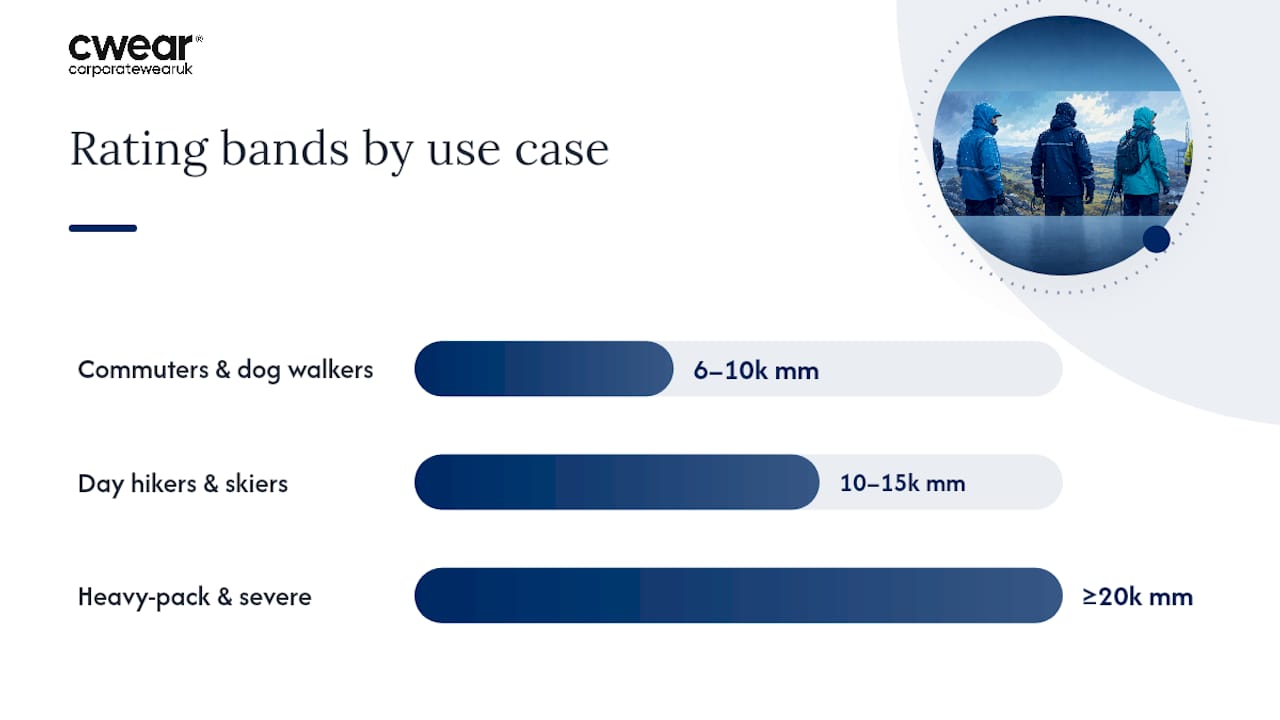
Quick guidance by use case: commuters and dog walkers are usually well served by 6,000 to 10,000mm; day hikers and resort skiers should look toward 10,000 to 15,000mm; anyone carrying a heavy pack, working outdoors all day, or heading into genuinely severe weather should push toward 20,000mm or beyond. There’s no single agreed industry threshold for what counts as “waterproof”, but many experts treat 10,000mm as a sensible practical baseline for anything beyond casual use.
How breathable does a waterproof jacket need to be?
Breathability is usually quoted as MVTR, measured in grams of moisture per square metre over 24 hours, where a higher number means more vapour escapes. Some brands instead quote RET, where lower numbers indicate better breathability.
Statistic: RET values of 0 to 6 are generally rated excellent, while anything above 20 is considered poor for active use, though real-world comfort depends heavily on how humid and warm conditions are when you’re wearing the jacket.
Both metrics are more fragile than the tidy number on a label suggests. MVTR and RET results are highly sensitive to test set-up, including the humidity differential used in the lab and the temperature the sample is tested at. A jacket that performs superbly in a controlled 40°C test chamber can still feel clammy on a muggy August hillside, because sweat production and ambient humidity in the real world rarely match laboratory conditions.
Rough targets by exertion level:
- Low exertion (commuting, dog walking): 5,000 to 10,000 g/m²/24h MVTR is usually adequate
- Moderate exertion (hiking, cycling): aim for 10,000 to 20,000 g/m²/24h
- High exertion (running, ski touring, manual work): look for 20,000 g/m²/24h or higher, and prioritise mechanical ventilation alongside the fabric spec
Experts caution that breathability figures often mislead because a single number can’t capture how a body actually generates and releases heat. Good mechanical ventilation and cut often matter more than the headline figure once you’re moving hard.
How do you balance waterproofing against breathability?
Start by identifying three things about how you’ll actually use the jacket: typical activity intensity, how long you’ll be exposed to wet weather in one go, and whether you’re carrying a loaded pack. A jacket bought for occasional dog walks doesn’t need the same spec as one bought for a week of hill walking with a 15kg rucksack.
- Set your waterproof rating target based on the activity bands above, erring upward if you’ll be sitting, kneeling, or carrying weight
- Set your breathability target based on exertion level, not just weather; high output activities need airflow more than they need extra mm
- Check seam sealing on the inside; taped seams at the shoulders, hood and hem stop water finding stitch holes
- Check ventilation features: pit zips, mesh-lined pockets, or a two-way front zip all matter more day to day than an extra 5,000mm on the label
- Check hood and cuff fit; a hood that doesn’t move with your head or cuffs that let wind in undermine an otherwise excellent fabric
- Confirm the fit allows a base and mid-layer without compromising freedom of movement, particularly across the shoulders
Construction details such as seam sealing, taped zips and hood design frequently determine real-world dryness more than the headline rating. A 30,000mm jacket with a poorly sealed hood will lose to a well-built 15,000mm jacket in genuinely wet conditions.
Pro Tip: Don’t chase the highest mm figure on the shelf. A mid-range rating with a well-ventilated design and properly taped seams will outperform a headline number on a jacket that traps heat and lets water creep through untaped stitching.
What are 2-layer, 2.5-layer and 3-layer jackets?
Layer construction shapes weight, durability and how the jacket ages, independent of the hydrostatic head figure printed on the label.
- 2-layer: an outer fabric bonded to a waterproof membrane, with a separate hanging liner inside for comfort; heavier and bulkier, but generally the most affordable and often the most durable against abrasion
- 2.5-layer: an outer fabric with a membrane, plus a thin printed or sprayed protective coating instead of a full liner; lighter and more packable, but the coating can wear thin faster under repeated flexing
- 3-layer: outer fabric, membrane and a lightweight inner layer all bonded together as one laminate; the lightest and most breathable of the three, generally the most durable in high-wear commercial use, but also the most expensive to produce
For corporate workwear that gets worn daily and washed often, 3-layer or a robust 2-layer construction tends to hold up best against repeated commercial laundering and abrasion from tools or site equipment. Casual outdoor wear can lean toward 2.5-layer for its packability, while serious alpine use almost always demands the durability of 3-layer laminates.
How do you maintain a waterproof jacket’s performance?
A jacket’s DWR coating is what makes rain bead and run off the surface rather than soaking into the outer fabric. DWR wears down with abrasion, dirt, and washing, and once it fails, the fabric “wets out”: it looks soaked even though the waterproof membrane underneath is still doing its job.
- Wash regularly with a technical cleaner rather than standard detergent, which can clog the membrane’s pores and leave residue on the DWR
- Tumble dry on low heat where the care label allows it; gentle heat helps reactivate DWR coatings better than air drying alone
- Reproof when water stops beading, using a wash-in or spray-on treatment designed for waterproof fabrics
- Inspect seam tape periodically for peeling or bubbling, particularly at the shoulders and hood, since damaged tape is a common source of leaks that has nothing to do with the fabric’s rating
- Send seam or zip repairs to a specialist rather than attempting DIY fixes, since incorrect resealing can trap moisture under the tape
Pro Tip: If rain is soaking straight into the fabric rather than beading on the surface, that’s a DWR failure, not a membrane failure. Reproofing first is far cheaper than assuming the jacket itself has failed.
How should businesses apply these criteria to branded workwear?
Procurement teams buying waterproof workwear for staff face the same fundamentals as any hillwalker, plus a few extra considerations. A durable garment needs to survive repeated commercial laundering, hold its branding through wear, and keep staff comfortable across a full shift outdoors.
A practical checklist includes: hydrostatic head suited to the role (site workers exposed all day need higher ratings than staff moving between indoor spaces), wash durability, seam sealing that survives repeated laundry cycles, and an outer weave robust enough to protect embroidery or print from abrasion. The most durable waterproof workwear tends to balance a mid to high hydrostatic head with a resilient outer weave and reproofable DWR, so branded decoration survives commercial washing rather than cracking or fading.
Cwear’s Kyoto jacket suits roles with regular outdoor exposure, such as site supervisors or delivery staff, while the Endurance softshell fits lighter-exposure roles needing wind and light rain protection rather than full waterproofing. Buyers weighing these choices against broader procurement needs may find it useful to read Cwear’s guidance on choosing custom corporate clothing, and Cwear’s customer service team can talk through case studies for specific sectors on request.
What actually matters when you wear a jacket all day
Ratings on a swing tag tell you what a fabric survives in a lab, not what it feels like at hour six of a wet shift or a long descent. Fit around the shoulders and a hood that turns with your head make more practical difference than an extra 5,000mm most days. Ventilation is the feature people underrate most: a jacket with pit zips and a breathable back panel at a moderate rating often beats a high-mm jacket with no airflow at all, because sweat trapped inside soaks you just as thoroughly as rain does.
Maintenance matters more than most buyers expect too. A jacket that’s had its DWR neglected for two years will underperform a cheaper jacket that’s been reproofed properly. When trying a jacket on, check three things: does the hood move with your head, can you reach overhead without the hem riding up, and does the fabric feel stiff and crackly (a sign of a worn coating) rather than supple.
— Vinay
Branded waterproof jackets built for the job: Kyoto and Endurance
Some suppliers put the same waterproof and breathability logic covered above into practical options, without forcing every team into a single spec regardless of role.

The Kyoto jacket suits staff who spend real time outdoors in wet conditions, construction supervisors, groundskeepers, hospitality staff on outdoor duty, or security personnel on exposed sites. The Endurance softshell is built for lighter exposure: staff moving between indoor spaces, retail teams stepping outside briefly, or education staff on yard duty who need wind and light rain protection without the bulk of a full waterproof shell. Both accept embroidery and print through Cwear’s decoration process, so branding survives alongside the garment rather than fading ahead of it.
If you’re procuring for a team rather than buying for yourself, it’s worth reading Cwear’s notes on what makes local suppliers reliable for custom workwear before placing a bulk order. Visit the Kyoto jacket page or the Endurance softshell page to check sizing and request a quote for branded quantities, or get in touch with Cwear’s customer service team to discuss embroidery placement and turnaround for your order.
Sources
- Hydrostatic head
- Simple guide to hydrostatic head testing
- Waterproof & breathability ratings explained
- Outerwear: waterproof ratings and breathability
- How rainwear works
FAQ
What is a good rating for a waterproof jacket?
For general outdoor use, 10,000 to 15,000mm hydrostatic head paired with around 10,000 g/m²/24h MVTR covers most hiking and everyday wet-weather needs. Heavier exposure or a loaded pack calls for 20,000mm or more.
Is 20,000mm waterproof rating good?
Yes, 20,000mm sits in the high-protection band, suitable for prolonged exposure, heavier packs, or demanding outdoor work. It’s well beyond what casual commuting or light showers require.
Is 30,000mm a good waterproof rating?
A 30,000mm rating is at the top end, aimed at severe, sustained wet conditions such as mountaineering or expedition use. For most everyday activities, it’s more capacity than you’ll ever need.
Is 5,000mm a good waterproof rating?
A 5,000mm rating handles light drizzle and short spells outdoors but isn’t built for sustained rain or any pressure from a rucksack strap. It suits casual, low-exposure wear rather than hiking or workwear.
Does a higher waterproof rating always mean a better jacket?
Not necessarily. Seam sealing, taped zips and hood design frequently determine real-world dryness more than the headline mm figure, so a well-built mid-range jacket can outperform a poorly constructed high-rated one.


