


GSM (grams per square metre) tells you how heavy and dense a fabric is. For workwear, lightweight fabrics (roughly 140–180 GSM) suit hot, low-abrasion roles, midweight (roughly 180–280 GSM) covers most everyday uniforms, and heavy fabrics (280–400+ GSM) handle jackets, coveralls and high-wear garments. Fibre, weave and finishing still shape how any given GSM performs in practice.
TL;DR:
- Confirm that fabric GSM is specified as a range with a tolerance of around plus or minus 10% and request test reports for finished, dyed fabric from the supplier.
- Choose lightweight GSM (100–180) for hot environments and low-abrasion roles, midweight (180–280) for most workwear like polos and trousers, or heavy (280–400+) for roles involving manual labor or outdoor exposure.
- Consider the job’s physical demands, laundering frequency, and decoration method when selecting GSM, rather than defaulting to heavier fabrics for safety or durability.
- Request samples at different GSM levels during prototyping to assess feel and comfort, helping to avoid overspending on unnecessarily heavy garments.
- Remember that GSM alone does not determine quality; fibre, knit structure, and finishing significantly influence garment durability and performance.
Table of Contents
- What GSM measures and how it’s tested
- What do different GSM bands mean for workwear?
- How do I choose the right GSM for my team?
- Which GSM suits different sectors and roles?
- How Corporatewear UK applies GSM in practice
- What procurement teams get wrong about GSM
- Get the right weight and finish for your team’s uniforms
- Sources
- FAQ
What GSM measures and how it’s tested
GSM stands for grams per square metre. It’s calculated by weighing a fabric sample, often a 10cm × 10cm swatch or a sample cut with a circular GSM cutter, then scaling that weight up to represent one square metre. The two reference standards that govern this measurement are ISO 3801 and ASTM D3776, which keep GSM figures comparable across mills, countries and suppliers.
Knowing the standard is one thing. Getting a trustworthy number out of a supplier is another. Before confirming a bulk order, ask for:
- A GSM test report on the dyed and finished fabric, not just the greige (unfinished) cloth, since wet processing changes weight.
- Test results from multiple points across the roll, not a single spot check.
- GSM specified as a range with an agreed tolerance, typically around ±5–10%, written into the purchase order.
If a supplier quotes in ounces per square yard rather than GSM, that’s a straightforward conversion (1 oz/yd² is roughly 33.9 GSM), but always ask them to confirm the GSM equivalent in writing. Specifying a single fixed number invites disputes when the actual fabric lands 15 GSM either side of target. A range with tolerance is what protects both sides.
What do different GSM bands mean for workwear?
Fabric weight sits on a spectrum, and each band brings a different feel, durability profile and decoration behaviour. Broad ranges vary by supplier, but the pattern holds across most workwear categories:
- Lightweight (100–180 GSM): soft drape, breathable, suited to hot environments or low-abrasion desk and front-of-house roles. Performance tees often sit around 150–200 GSM. Decoration options are more limited here, since thin fabric can pucker under dense stitching.
- Midweight (180–280 GSM): the workhorse range for polos, shirts and trousers. Premium tees and polos typically land between 200–280 GSM, offering enough structure to hold shape through repeated washing without feeling stiff.
- Heavyweight (280–400 GSM): structured, durable, built for abrasion and frequent handling. Hoodies commonly run 300–400 GSM. This band suits roles involving manual tasks, tool use or outdoor exposure.
- Ultra-heavy (400+ GSM): reserved for outerwear, coveralls and specialist protective garments where longevity outweighs comfort in mild conditions.
Workwear specifically tends to map to a narrower set of bands: 140–180 GSM for lightweight shirts, 180–280 GSM for everyday polos and trousers, and 280–400+ GSM for jackets and heavy-duty coveralls. A hospitality polo and a site jacket have almost nothing in common on this scale, and that’s exactly the point. Matching the band to the job, rather than defaulting to “heavier is safer”, keeps both comfort and budget in check.
How do I choose the right GSM for my team?
Treat GSM selection as a checklist item in your sourcing brief, not an afterthought once the design is signed off. Work through it in this order:
- Assess the physical demands of the role. High-abrasion, high-mobility jobs (warehouse, trades, security patrol) justify heavier fabric; desk-based or hospitality roles rarely do.
- Factor in laundering frequency. Garments washed daily or industrially need fabric that holds structure through repeated cycles, which usually pushes towards the midweight-to-heavy end.
- Match GSM to decoration method. Dense embroidery generally needs a stable base, often 250 GSM or above, while DTG and screen printing depend more on surface smoothness and fibre content than raw weight.
- Specify a range with tolerance, not a single number, and request the factory’s test report on finished fabric.
- Ask for physical swatches at two different weights during prototyping, so decision-makers can feel the trade-off rather than compare numbers on a spec sheet.
- Weigh lifecycle cost. A heavier garment costs more upfront but may outlast two lighter replacements, or it may simply add unnecessary weight and cost if the role never demands that durability.
Pro Tip: Request two sample weights at prototyping stage, one at the lower end of your target band and one at the upper end. Feeling the difference in hand tells you more in thirty seconds than any spec sheet will.
Which GSM suits different sectors and roles?
Sector context does most of the decision-making for you once you know the bands. A few patterns come up repeatedly across bulk uniform orders:
- Hospitality: breathable midweight fabrics keep front-of-house staff comfortable through long shifts while still looking presentable at close range.
- Retail and corporate offices: midweight to premium fabric, roughly 200–280 GSM, balances a sharp appearance with the wash durability that repeated wear demands.
- Education: durable polos in the 200–260 GSM range cope with frequent institutional laundering without losing shape term after term.
- Security and outdoor roles: heavier, structured jackets and outerwear, typically 280–400+ GSM, hold up against weather exposure and constant movement.
- Construction and heavy trades: heavy-duty fabrics dominate, and suppliers working in imperial units will often quote ounces per square yard rather than GSM, so confirm the conversion before signing off.
None of these bands are rigid boundaries. A security role that’s mostly static indoor monitoring might sit comfortably in midweight rather than heavyweight, and a construction office role might need nothing heavier than a standard polo. The sector points you toward a starting band; the actual job still decides the final figure.
How Corporatewear UK applies GSM in practice
Corporatewear UK has spent over 25 years supplying personalised, branded workwear across construction, hospitality, education and security, and GSM sits at the centre of every tech pack that goes to production. Specifying a range with tolerance, rather than chasing a single perfect number, is standard practice on every bulk order.
Decoration capability shapes the recommendation too. Advanced embroidery and printing technology means garments are matched to a fabric weight band that keeps stitching stable and print surfaces smooth, without sacrificing the durability a role demands.
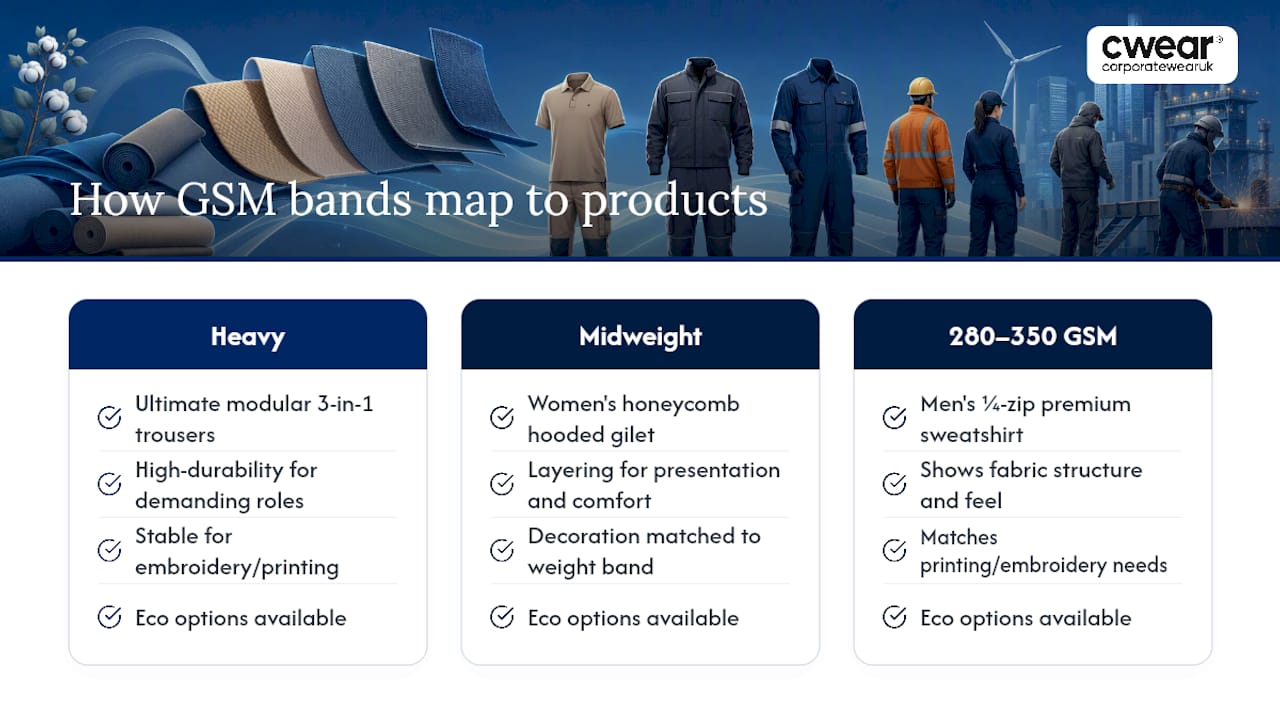
Three products illustrate how the bands play out in real garments: the Ultimate modular 3-in-1 trousers sit at the heavier, high-durability end for demanding roles; the Women’s honeycomb hooded gilet works as a midweight layering piece for presentation and comfort; and the Men’s ¼-zip premium sweatshirt demonstrates the structure and feel of fabric in the 280–350 GSM range. Eco-friendly fabric options are available across these categories for businesses prioritising sustainability.
What procurement teams get wrong about GSM
The most common mistake in uniform sourcing is treating GSM as a proxy for quality. It isn’t. A 250 GSM polo made from poor-quality yarn with sloppy finishing will fail faster than a well-constructed 200 GSM garment, and no amount of fabric weight fixes a bad knit structure or a rushed dye process.
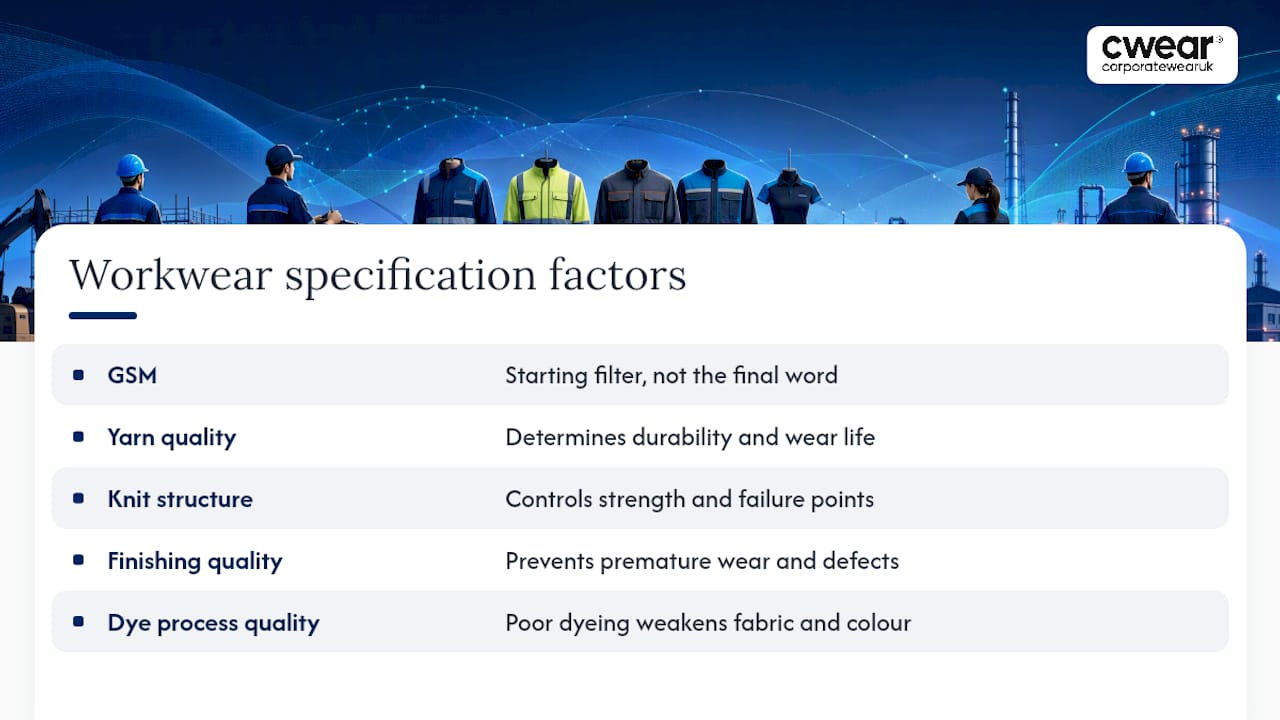
Conventional advice tends to push buyers toward “go heavier to be safe”, which quietly inflates cost and, for warm-environment roles, actively hurts comfort and compliance with the garment. The more useful instinct is to work backwards from the job: abrasion, movement, wash frequency, decoration method, then let those factors narrow the band. GSM is a starting filter, not the final word.
If there’s one habit worth adopting immediately, it’s insisting on a documented tolerance and a test report before bulk production runs, rather than trusting a single number on a spec sheet. That single change catches more sourcing problems than any amount of debating whether 220 or 240 GSM is “correct” for a given role.
— Vinay
Get the right weight and finish for your team’s uniforms
Manufacturers turn GSM decisions into finished uniforms without the back-and-forth of briefing an agency from scratch. Ordering support may cover artwork mockups, bulk pricing, embroidery and printing capability, and showroom visits where you can handle sample weights in person before committing to a production run.

The Ultimate modular 3-in-1 trousers, Women’s honeycomb hooded gilet and Men’s ¼-zip premium sweatshirt all serve as practical starting points if you’re mapping GSM bands to specific roles across your team. For a deeper look at how decoration technique interacts with fabric choice, the guide on custom embroidery that lasts is worth a read before you finalise a tech pack.
Request a quote or browse the full range online to get sample weights and pricing against your specification.
FAQ
What Is GSM in Clothing?
GSM stands for grams per square metre, a measurement of fabric weight calculated by scaling up a small weighed sample, typically 10cm × 10cm, to represent one full square metre.
What GSM Is Best for Workwear Polos?
Everyday workwear polos generally perform best between 180 and 280 GSM, giving enough structure to survive frequent laundering without feeling stiff.
Does Higher GSM Always Mean Better Quality?
No. Fibre content, knit structure and finishing affect durability and feel as much as weight, so a heavier fabric isn’t automatically the better-performing one.
How Should I Specify GSM When Ordering Bulk Uniforms?
Specify GSM as a range with an agreed tolerance, commonly around ±5–10% (10%), and request a supplier test report on the finished fabric rather than accepting a single fixed figure.
Can Cwear Help Me Choose the Right GSM for My Team?
Yes. Some suppliers specify GSM ranges directly in tech packs and can provide sample swatches at different weights so you can compare feel and durability before committing to a bulk order.


